AI Overview
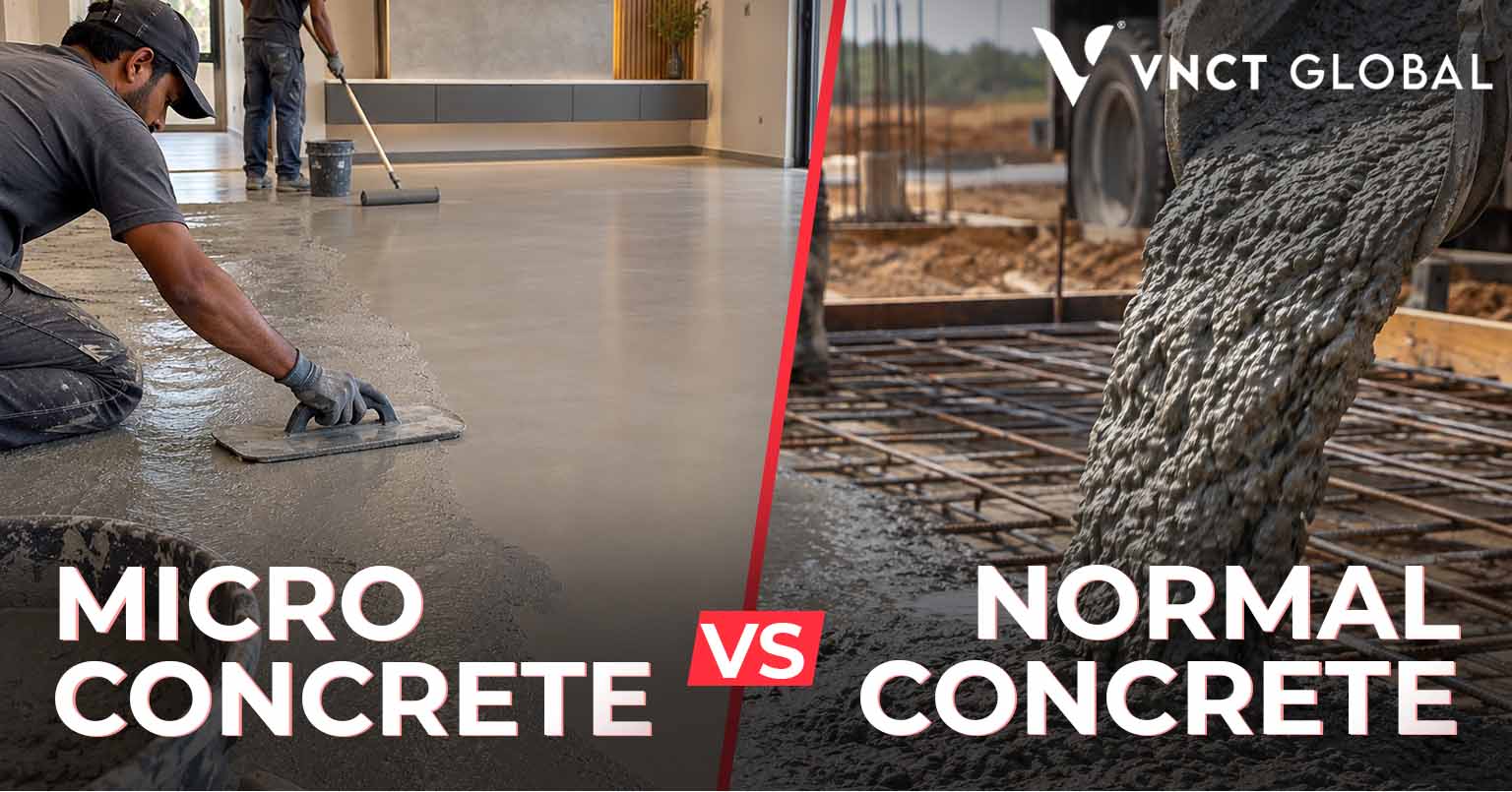
Micro Concrete vs Normal Concrete Guide: Micro concrete and normal concrete are not simply thinner and thicker versions of the same material. They are generally selected for different purposes. Normal concrete is primarily a structural construction material used for foundations, slabs, columns, beams, footings and other load-bearing elements. Micro concrete can refer to a specialised cementitious material used either for decorative surface finishes or, in structural repair products, for areas where conventional concrete placement and vibration are difficult.
For decorative residential applications, micro concrete can create a continuous, contemporary concrete-style finish on suitable prepared surfaces. Normal concrete, by contrast, is normally part of the building’s structural system. The correct choice depends on the purpose, substrate, strength requirement, thickness, location, design objective, workmanship and manufacturer’s specifications.
One important point is that the term micro concrete is used in more than one context. Some suppliers use it for decorative architectural finishes, while construction-chemical manufacturers use micro concrete for high-strength, flowable, non-shrink repair work. Therefore, homeowners should always check the technical specification instead of choosing a product based only on its name.
Introduction
Micro Concrete vs Normal Concrete Guide is useful for anyone planning a modern home, renovation, villa interior or construction project and wondering why two materials that both contain cement can have such different applications. At first glance, micro concrete may look like a smaller-scale version of ordinary concrete, but the difference is more practical than the name suggests.
Normal concrete has been a fundamental construction material for decades. It is commonly used to create foundations, footings, columns, beams, floor slabs, retaining structures and other components that form the physical framework of a building. Its mix design, reinforcement, thickness and strength are selected according to structural requirements.
Micro concrete, however, is a broader term. In decorative architecture, it may describe a thin cement-based surface system intended to produce a seamless, concrete-inspired appearance over an appropriate substrate. In structural repair, micro concrete can instead mean a flowable, high-strength, non-shrink cementitious repair material designed for locations where conventional concrete placement or vibration is difficult.
This distinction matters when planning a home.
A homeowner looking for a contemporary floor finish should not compare decorative micro concrete directly with structural concrete as though they were interchangeable flooring products. Likewise, someone repairing a damaged RCC column should not select a decorative surface coating simply because it is marketed as “micro concrete.”
The right material depends on what the building needs to achieve.
For NRIs planning a villa or construction project in India from overseas, this becomes even more important. Material selection can affect the appearance, construction sequence, maintenance requirements, budget and long-term performance of a property. A clear understanding before approving materials can reduce unnecessary changes later.
This guide explains the difference in simple terms, compares their applications, advantages and limitations, discusses cost considerations, explains where micro concrete can work in a modern villa and highlights how professional villa developers such as VNCT GLOBAL can help NRI homeowners make practical decisions.
Micro Concrete vs Normal Concrete – What Is the Basic Difference?
The simplest way to understand the difference is to look at their purpose rather than their names.
Normal concrete is generally used as a structural or construction material. It is mixed and placed in substantial sections and may be reinforced with steel bars or other reinforcement systems. Depending on the design, it can form a major part of a building’s structural framework.
Micro concrete can have a completely different role.
In decorative applications, it is generally used as a specialised cementitious surface finish. It can provide a seamless, contemporary mineral or concrete-like appearance without constructing a conventional concrete slab solely for aesthetic purposes. Some systems are applied in relatively thin layers over suitably prepared existing surfaces.
In structural repair, micro concrete is different again. Certain products are designed as flowable repair materials for damaged beams, columns and other RCC elements, particularly where access is restricted or conventional compaction is difficult.
So, rather than asking:
“Which one is stronger?”
a better question is:
“What job is the material expected to perform?”
That question immediately makes the comparison clearer.
What Is Normal Concrete?
Normal concrete is one of the most widely used construction materials in residential and commercial building projects.
A conventional concrete mix generally combines cement, fine aggregate, coarse aggregate and water, with admixtures added when required. The proportions are selected according to the required performance and project specifications.
In a typical villa project, normal concrete may be used for:
- Footings
- Foundations
- Columns
- Beams
- RCC slabs
- Staircases
- Retaining structures
- Certain external works
- Pavements and hardscape elements
- Other structural or construction components
The actual mix design should be determined according to structural requirements rather than simply choosing a concrete grade based on appearance.
For example, a structural engineer may specify a particular grade for an RCC element after considering loads, span, reinforcement, environmental conditions and relevant design requirements.
Normal concrete is therefore not primarily selected because it looks attractive.
Its first job is performance.
The concrete needs to work as part of a larger structural system that includes reinforcement, foundations, soil conditions, structural detailing and construction quality.
This is why replacing normal structural concrete with a decorative micro concrete finish is not a valid substitution.
What Is Micro Concrete?
The term micro concrete needs some clarification because the construction industry uses it in different ways.
In decorative architecture, micro concrete can refer to a cement-based surface system used to create a continuous, contemporary, concrete-inspired finish on suitable surfaces. Such systems can be used for floors, walls and other architectural elements depending on the manufacturer’s specifications.
The objective is usually visual and functional surface enhancement rather than replacing a building’s primary structural concrete.
A decorative micro concrete system may be applied in thin layers, making it particularly interesting for renovation projects where homeowners want to change the appearance of an existing surface without removing the entire substrate.
The finished appearance can vary according to the product, application technique, texture, pigment, sanding process and sealer.
That means two micro concrete installations can look noticeably different even though they use similar terminology.
There is another category worth mentioning.
Some construction products marketed as micro concrete are specifically engineered for structural repairs. These products can be flowable, high-strength and non-shrink, allowing them to fill areas where conventional concrete may be difficult to place or compact.
Therefore, always ask:
Is this decorative micro concrete or structural repair micro concrete?
That single question can prevent a lot of confusion.
Micro Concrete vs Normal Concrete – Side-by-Side Comparison
| Factor | Micro Concrete | Normal Concrete |
| Primary purpose | Often decorative surface finishing or specialised repair | Structural and general construction |
| Typical thickness | Depends on the product/system; decorative systems can be thin | Generally substantially thicker in structural applications |
| Appearance | Contemporary, seamless, mineral or concrete-inspired | Conventional concrete appearance unless specially finished |
| Structural role | Decorative micro concrete should not be treated as structural concrete | Commonly forms part of structural systems |
| Application | Can be trowel/applied as a surface system or placed as specialised repair material | Usually mixed, placed and compacted according to construction requirements |
| Existing surfaces | Some decorative systems can be applied over suitable prepared substrates | Generally forms a new construction element |
| Renovation suitability | Often attractive for suitable renovation applications | Usually requires more extensive construction work when replacing existing surfaces |
| Design flexibility | High for decorative applications | More limited as a decorative finish unless specially treated |
| Load-bearing use | Depends entirely on the specific engineered product; decorative systems should not be assumed structural | Widely used for structural elements when properly designed |
| Maintenance | Depends on finish and sealer | Depends on concrete finish, exposure and use |
| Selection | Based on system, substrate, application and design | Based on structural and construction requirements |
The most important lesson from the table is that these materials should not be treated as direct substitutes.
A decorative micro concrete floor is not an alternative to an RCC slab.
An RCC slab is not simply a thicker version of decorative micro concrete flooring.
They serve different purposes.
Why Is Micro Concrete Becoming Popular in Modern Homes?
Modern residential design has moved beyond the idea that every floor and wall must be finished with traditional tiles, stone or paint.
Homeowners increasingly look for surfaces that create visual continuity.
A seamless concrete-inspired finish can help achieve that look.
Instead of having grout lines between tiles, decorative micro concrete systems can create a continuous surface where the product and substrate are suitable. This minimalist appearance is particularly relevant to contemporary interiors, industrial-inspired homes and modern villas.
Micro concrete can also become part of a broader material palette.
For example, a designer might combine:
- Micro concrete
- Natural wood
- Glass
- Metal
- Stone
- Warm lighting
- Neutral paint colours
- Indoor plants
The result can be modern without making the home feel cold.
This is one reason cement-inspired finishes are increasingly seen in premium residential interiors.
However, appearance should never be the only selection criterion.
A good-looking finish that is unsuitable for the substrate or application can become an expensive mistake.
Where Can Micro Concrete Be Used in a Villa?
Depending on the selected product and system, decorative micro concrete can be considered for a range of residential surfaces.
1. Living Room Floors
The living room is one of the most visible areas of a villa.
A seamless floor can create a clean visual connection between the living room, dining area and other open-plan spaces.
The absence of conventional grout lines can also make the floor appear visually less interrupted.
For a large villa, this can help create a strong architectural identity.
2. Feature Walls
Micro concrete can also be used to create a feature wall.
Instead of using wallpaper, stone cladding or decorative panels, a homeowner may choose a cement-inspired finish to give the wall a more architectural appearance.
Lighting becomes important here.
Wall-washing lights can highlight subtle texture and tonal variation, while softer lighting can make the same surface appear calmer.
3. Staircases
Some decorative surface systems can be considered for stair applications, but staircases require careful detailing.
The selected product must be appropriate for the application, and slip resistance, edge detailing, substrate movement and durability should be assessed.
This is not an area where a homeowner should rely only on photographs from another project.
4. Bathrooms
Micro concrete is sometimes used in bathrooms and wet areas as part of a properly specified and sealed system.
However, homeowners should not assume that every micro concrete product is automatically waterproof.
Wet areas need proper waterproofing behind the finish, suitable detailing at corners and joints, appropriate drainage and a compatible finishing/sealing system.
The material should be selected specifically for the intended wet-area application.
5. Kitchen Areas
Micro concrete can provide a clean, contemporary appearance in kitchens.
It may be considered for floors, walls and, with the right system, certain counters or surfaces.
But kitchen surfaces face stains, heat, moisture, cleaning chemicals and physical impact.
Therefore, product specifications and sealing requirements matter.
6. Outdoor Areas
External applications require additional caution.
Temperature changes, rain, direct sunlight, substrate movement and moisture exposure can affect surface systems.
A decorative micro concrete product intended for interiors should not automatically be used outdoors.
Always verify that the specific system is rated for exterior exposure.
Where Is Normal Concrete Used in a Villa?
Normal concrete has a completely different responsibility.
In a conventional RCC villa, concrete is used throughout the structural framework.
Typical applications include:
Foundation
The foundation transfers loads from the building into the ground.
Footings
Footings distribute structural loads to the soil.
Columns
Columns transfer vertical loads through the building.
Beams
Beams transfer loads from slabs and other elements to columns or supports.
Slabs
RCC slabs form floors and roofs in many residential buildings.
Staircases
Depending on the design, concrete staircases can be structural elements within the building.
Retaining Structures
Concrete may also be used for retaining walls and other external structural requirements.
These applications require structural design.
A decorative surface finish cannot replace the structural function of these elements.
Micro Concrete vs Normal Concrete: Strength
Strength is one of the areas where online comparisons can become misleading.
It is tempting to say:
“Normal concrete is strong and micro concrete is weak.”
That is too simplistic.
The word micro concrete describes different types of products and systems.
A decorative micro concrete coating is not intended to perform like a structural RCC beam.
At the same time, structural repair micro concrete can be a high-strength engineered material specifically designed for repairs. Some products are formulated to be flowable and non-shrink and can be used in applications such as column and beam repairs.
Therefore, strength should always be evaluated using the specific product’s technical data sheet and the project’s engineering requirements.
For a villa project, the structural engineer should determine the concrete grade required for structural elements.
For decorative surfaces, the installer should follow the manufacturer’s system requirements.
Do not compare two materials solely by their names.
Micro Concrete vs Normal Concrete for Renovation
This is one area where micro concrete can have a practical advantage.
Renovation projects often have restrictions that new construction does not.
There may be:
- Existing flooring
- Existing walls
- Door-height limitations
- Furniture
- Plumbing
- Electrical installations
- Occupied rooms
- Limited demolition space
- Disposal requirements
- Tight project schedules
A thin decorative surface system can sometimes reduce the amount of demolition involved.
Some microcement and micro concrete systems are specifically promoted for application over suitable existing hard surfaces.
However, this should never be interpreted as “no preparation required.”
A successful installation depends heavily on the condition and stability of the substrate.
If the existing floor is loose, cracked, damp or structurally unstable, applying a decorative finish over it will not magically solve the underlying problem.
In simple terms:
A beautiful finish cannot compensate for a poor substrate.
Micro Concrete vs Normal Concrete: Installation Process
Normal Concrete Installation
A conventional concrete construction process can involve:
- Structural planning
- Formwork
- Reinforcement placement
- Concrete mix design
- Batching
- Transportation
- Placement
- Compaction
- Levelling
- Curing
- Finishing
- Quality checks
The exact process depends on the structural element and project requirements.
Concrete placement needs proper supervision because defects at this stage can affect structural performance.
Decorative Micro Concrete Installation
A decorative micro concrete installation can involve a different sequence.
A typical system may include:
- Substrate inspection
- Cleaning
- Repairing defects
- Crack treatment where required
- Primer or bonding layer
- Base coat
- Reinforcement mesh where specified
- Micro concrete layers
- Drying or curing between coats
- Sanding or surface refinement
- Final coat
- Sealing
- Final inspection
The exact system varies by manufacturer.
Some systems require specific primers, base coats, meshes, sealers and curing periods.
This is why professional installation matters.
Why Surface Preparation Matters
Surface preparation is probably one of the least exciting parts of the project, but it is one of the most important.
Imagine installing a premium finish over a floor that is moving underneath it.
The finish may look perfect when completed.
Then cracks appear.
The homeowner may blame the micro concrete.
But the real issue could be the substrate.
Before installation, the team should examine:
- Surface stability
- Cracks
- Moisture
- Existing joints
- Uneven areas
- Contamination
- Dust
- Loose materials
- Previous coatings
- Compatibility with the proposed system
This is also why comparing products only on price can be misleading.
The final cost includes preparation, labour, materials, finishing, sealing and correction work when required.
Advantages of Micro Concrete
1. Seamless Appearance
The lack of conventional tile grout lines can create a clean, continuous appearance.
This works particularly well with minimalist interiors.
2. Contemporary Design
Micro concrete can provide a modern mineral or concrete-inspired character.
3. Renovation Potential
Suitable systems may be installed over certain existing surfaces, reducing demolition in some renovation projects.
4. Design Flexibility
Depending on the product, homeowners may have options for colour, texture and finish.
5. Visual Continuity
A consistent surface language can be carried between different parts of an interior when the system is suitable for those applications.
6. Relatively Low Material Build-Up
Decorative micro concrete systems can be much thinner than conventional concrete construction.
7. Modern Architectural Character
For homeowners who prefer contemporary or industrial-inspired interiors, the material can become a defining design feature.
Limitations of Micro Concrete
Micro concrete is not a magic material.
It has limitations.
1. Skilled Installation Is Important
The final appearance depends heavily on preparation, application technique and finishing.
2. Substrate Movement Can Cause Problems
If the underlying substrate moves or cracks, the finish may be affected.
3. Sealing May Be Required
Depending on the system, a protective sealer may be required to improve resistance to moisture, stains and everyday use.
4. Product Quality Varies
“Micro concrete” is not a universal standardised product name.
Different manufacturers can offer different formulations.
5. Repair Can Be Visible
A local repair may not always perfectly reproduce the surrounding texture and tonal variation.
6. Not Every Surface Is Suitable
The manufacturer’s requirements must be checked before application.
Advantages of Normal Concrete
Normal concrete remains the foundation of modern construction for good reasons.
Structural Capability
It can form critical load-bearing components when properly designed and reinforced.
Availability
Concrete materials and construction expertise are widely available in India.
Versatility
It can be used for foundations, columns, beams, slabs and numerous other construction applications.
Engineering Control
Concrete grades, reinforcement and structural detailing can be designed according to project requirements.
Long-Term Performance
When properly designed, placed, compacted, cured and maintained, concrete can provide long service life.
Limitations of Normal Concrete as a Decorative Finish
Normal concrete is not necessarily the most convenient choice when the goal is purely decorative.
A conventional concrete slab can involve:
- Greater thickness
- More construction work
- Structural planning
- Formwork
- Reinforcement
- Curing
- Heavier construction
- Greater demolition requirements during renovation
For a new structural floor, this may be completely appropriate.
For a homeowner trying to update an existing interior without major demolition, it may not be the most practical route.
This is where specialised surface systems can become interesting.
Micro Concrete vs Normal Concrete – Cost Considerations
There is no single nationwide price that can accurately answer which material is cheaper.
Cost depends on:
- Product brand
- Grade
- Surface area
- Substrate condition
- Labour
- Number of coats
- Primer requirements
- Reinforcement
- Sealer
- Surface preparation
- Location
- Accessibility
- Design complexity
- Project scale
Structural micro concrete repair products also vary significantly in price depending on grade and performance requirements. Indian suppliers list different prices for different products, while technical repair products can carry additional costs because of their specialised formulation.
For decorative micro concrete, installation cost should not be compared with the price of ordinary cement alone.
The relevant comparison is the complete installed system.
For example:
Material + preparation + labour + finishing + sealer + wastage + site conditions = actual project cost.
This gives a more realistic budget.
Is Micro Concrete More Expensive Than Normal Concrete?
For a structural construction project, comparing the price of decorative micro concrete with conventional concrete per kilogram or per bag does not make sense.
They have different functions.
A decorative micro concrete floor may appear more expensive per square foot than basic concrete because you are paying for a specialised finish, skilled labour, preparation and protection.
But if the alternative involves demolition of an existing floor, disposal, new screed, new flooring and additional labour, the overall renovation calculation can be different.
Therefore, compare complete project costs, not individual material prices.
Which Is Better for a New Villa?
For a new villa, the answer may be:
Both.
Normal concrete can be used for the structural framework.
Decorative micro concrete can potentially be used for selected architectural surfaces.
There is no requirement to choose one material for the entire house.
A well-designed villa may use:
- RCC for the structural frame
- Tiles in selected areas
- Natural stone in feature spaces
- Wood or wood-look finishes
- Micro concrete for specific floors or walls
- Glass for visual openness
- Metal for architectural details
The strength of modern design is that materials can be selected according to function.
Micro Concrete for Luxury Villas
In premium villas, material selection often goes beyond basic functionality.
The homeowner may want a property that feels visually consistent from the entrance through the living areas.
Micro concrete can support this concept when used selectively.
For example, a contemporary villa might use a muted micro concrete finish on a feature wall, combined with warm timber, soft lighting and natural stone.
Another villa might use a concrete-inspired floor throughout the open-plan living area while introducing wood in the bedrooms.
The objective is not to cover every surface with the same material.
The objective is to create balance.
This is particularly relevant to best villa projects in Chennai, where modern architectural design often needs to respond to local climate, lifestyle and maintenance expectations.
Choosing Materials for Villas in Chennai
Chennai’s climate needs to be considered when selecting construction and finishing materials.
Heat, humidity, seasonal rain and moisture exposure can affect materials differently.
For interior applications, micro concrete may be considered for suitable surfaces where the substrate and system meet the required conditions.
For external or wet areas, additional technical evaluation is important.
This is one reason why villas in Chennai should not simply copy a material palette from a villa in another climate.
The design may look similar, but the construction specification should respond to local conditions.
What About Villas in Madurai?
The same principle applies to villas in Madurai.
A homeowner may want a contemporary interior with seamless floors or concrete-inspired walls, but the material should still be selected according to the intended application and local site conditions.
A good villa is not defined only by its visual style.
It is defined by how the structure, materials, services, climate response and lifestyle work together.
What About Villas in Coimbatore?
For villas in Coimbatore, homeowners may similarly consider micro concrete for contemporary interiors, feature walls or selected architectural surfaces.
But the same technical questions remain:
- Is the substrate suitable?
- Is the product intended for the application?
- Is the area exposed to water?
- What level of traffic will the surface receive?
- What maintenance is expected?
- How will the finish connect to adjoining materials?
The answers should come before final material approval.
How VNCT GLOBAL Can Support NRI Homebuyers
For an NRI homeowner, selecting construction materials can be more complicated because the decision-making process often happens from another country.
You may be living in:
- Dubai
- Singapore
- Qatar
- The United States
- The United Kingdom
- Australia
- Or another country
Meanwhile, your villa project is progressing in India.
That distance makes communication and transparency especially important.
VNCT GLOBAL can support NRI clients by helping coordinate the villa development process, communicate project updates and guide homeowners through important construction and design decisions.
For an NRI, the objective should not simply be:
“Build my villa.”
It should be:
“Help me understand what is being built, why it is being selected and how the project is progressing.”
That is where structured communication becomes valuable.
Material Selection Support for NRIs
When discussing materials such as micro concrete, an NRI homeowner should ideally receive clear information about:
Where the material will be used
For example, floor, wall, bathroom, staircase or feature area.
Why it is being recommended
The homeowner should understand the design or functional reason.
What preparation is required
Existing surfaces may need repairs before application.
What the expected finish is
A sample or reference finish can help set expectations.
What maintenance is involved
The homeowner should know how the surface needs to be cleaned and maintained.
What alternatives exist
The final decision should be based on the project’s priorities rather than a single material.
This approach can make remote decision-making easier.
VNCT GLOBAL and Transparent Villa Development
A homeowner investing in a villa wants more than attractive marketing images.
They want confidence that the project is being handled systematically.
For NRI homeowners, this can include:
- Project progress updates
- Construction-stage communication
- Material discussions
- Design coordination
- Documentation support
- Clarification of construction decisions
- Regular communication with the project team
- Assistance with understanding project milestones
The exact services available should be confirmed directly with the VNCT GLOBAL team.
If you are researching best villa developers in India, do not judge a developer only by the final photographs. Look at construction quality, communication, transparency, design coordination and after-sales support.
The same applies when comparing the largest villa developers in India. A large portfolio may demonstrate experience, but your individual project’s execution and communication still matter.
For NRIs, these factors can be especially important because they may not be able to visit the site regularly.
How NRIs Can Make Better Material Decisions From Abroad
If you are an NRI planning a villa, ask your developer or project team for five things before approving an unfamiliar material.
1. Product Information
Ask for the product name, manufacturer and technical specification.
2. Application Details
Ask exactly where it will be used.
3. Sample
Request a physical sample or high-quality sample images under realistic lighting.
4. Maintenance Information
Understand cleaning, sealing and repair requirements.
5. Alternative Options
Ask what the project would use if micro concrete were not selected.
This gives you enough information to make an informed decision without being physically present at the site.
Micro Concrete vs Normal Concrete for Interior Design
Interior designers often choose materials according to how they influence the overall room rather than treating each material independently.
Micro concrete can work particularly well with:
Wooden Elements
Warm timber can balance the cooler visual character of cement-based finishes.
Soft Furnishings
Rugs, curtains and upholstery can make a concrete-inspired room feel warmer.
Natural Stone
Stone can add texture and visual variation.
Indoor Plants
Greenery can provide contrast against neutral surfaces.
Warm Lighting
Warm lighting can soften the appearance of grey or earthy finishes.
Minimalist Furniture
Simple furniture can complement a seamless floor without creating visual clutter.
This is why material selection should happen alongside interior planning rather than after everything else has been finalised.
Micro Concrete vs Tiles
Although the topic is micro concrete vs normal concrete, homeowners often ask how micro concrete compares with tiles.
Tiles provide:
- Large variety of designs
- Established installation methods
- Easy replacement of individual pieces
- Different price ranges
- Many textures and colours
Micro concrete can provide:
- Seamless appearance
- Minimal visual joints
- Contemporary concrete-inspired character
- Potential renovation applications
- Continuous surface design
Neither is automatically better.
The choice depends on the project’s design, budget, maintenance expectations and technical requirements.
Micro Concrete vs Polished Concrete
These are also commonly confused.
Polished concrete generally involves mechanically grinding and polishing a concrete surface.
Micro concrete, in decorative applications, is typically a surface-applied system rather than simply polishing an existing structural slab.
This creates a major difference in construction approach.
Polished concrete depends heavily on the underlying concrete slab and aggregate exposure.
Micro concrete can be selected as a separate surface system where the substrate is suitable.
Again, they may look similar in photographs, but their installation processes are different.
How to Select the Right Micro Concrete Product
Before approving a product, consider the following.
Application
Is it for a floor, wall, bathroom, staircase or furniture?
Substrate
Is the existing surface compatible?
Thickness
What is the complete system build-up?
Moisture
Can the system handle the expected moisture exposure?
Traffic
Is the floor residential, commercial or high traffic?
Sealer
What sealer is recommended?
Maintenance
What cleaning products should be used?
Warranty
What warranty is offered and under what conditions?
Installer
Does the installer have experience with the specific system?
These questions are more valuable than simply asking:
“How much per square foot?”
Micro Concrete for a Contemporary Villa: A Practical Example
Imagine an NRI homeowner planning a modern villa in Chennai.
The design includes:
- Open-plan living room
- Dining area
- Large windows
- Minimalist staircase
- Neutral walls
- Wooden furniture
- Contemporary lighting
The homeowner wants a seamless floor rather than conventional tile joints.
One option could be a suitable decorative micro concrete system for selected interior areas.
The structural building would still rely on conventional engineered concrete and reinforcement.
This is the key point:
Micro concrete can complement normal concrete; it does not necessarily replace it.
The two materials can exist within the same villa because they serve different purposes.
What Should You Ask Your Villa Developer?
Before approving a micro concrete finish, ask:
- What exact product are you proposing?
- Is it decorative or structural micro concrete?
- Where will it be applied?
- What is the existing substrate?
- What preparation is required?
- What is the expected thickness?
- Is a primer required?
- Is reinforcement mesh required?
- How many coats will be applied?
- What sealer will be used?
- How long will the installation take?
- What maintenance is required?
- What happens if cracks appear?
- Is the product suitable for wet areas?
- What warranty is provided?
These questions help turn a vague material choice into a documented construction decision.
Micro Concrete and NRI Villa Investments
For NRIs, the villa is often both a lifestyle asset and a significant financial investment.
The decision-making process therefore needs to balance:
Design + Quality + Cost + Maintenance + Long-Term Value
Choosing an attractive finish is only one part of the process.
A villa should also be planned around:
- Location
- Construction quality
- Structural design
- Water management
- Electrical systems
- Plumbing
- Waterproofing
- Ventilation
- Security
- Maintenance
- Future resale considerations
This broader perspective is important when evaluating best villa developers in India.
It is equally important when researching the largest villa developers in India.
The developer’s ability to coordinate all these elements is ultimately more important than one individual finishing material.
VNCT GLOBAL Projects and Modern Villa Design
VNCT GLOBAL works in the premium villa segment, where architectural planning, construction quality and lifestyle requirements need to work together.
Project names such as Brookside Residences, Palm Shore, Palm Beach, Creek Residences, Park Villas and Ocean Drive Villas reflect the wider range of residential concepts associated with modern villa living.
For prospective buyers, the important step is to understand the exact specifications, location, construction scope and available customisation options for the project being considered.
If you are exploring best villa projects in Chennai, material selection should be considered alongside the project’s overall architecture, amenities, location and construction specifications.
Likewise, buyers comparing best villa projects in Coimbatore or best villa projects in Madurai should evaluate the complete development rather than focusing on one design trend.
A Note for NRIs Looking at Chennai Villas
Chennai continues to attract NRI buyers because of its connectivity, employment ecosystem, education, healthcare, family connections and long-term residential potential.
But buying a villa remotely requires careful due diligence.
Before making a decision, NRIs should review:
- Project location
- Developer credentials
- Approvals
- RERA details where applicable
- Land and title documentation
- Construction specifications
- Payment schedule
- Handover commitments
- Maintenance arrangements
- Legal documentation
- Site progress
Material choices such as micro concrete come later in the overall decision-making process.
The first priority should always be a legally and technically sound property.
Micro Concrete vs Normal Concrete: Which One Should You Choose?
The answer depends on the application.
Choose Normal Concrete When:
- You need a structural component.
- You are constructing foundations.
- You are building columns.
- You are constructing beams.
- You are casting structural slabs.
- The structural engineer has specified conventional concrete.
- Load-bearing performance is required.
Consider Decorative Micro Concrete When:
- You want a contemporary surface.
- You want fewer visible joints.
- You are renovating an existing suitable surface.
- You want a concrete-inspired appearance.
- You want to coordinate floors and walls visually.
- The selected product is suitable for the intended application.
- You have professional installation support.
Consider Structural Micro Concrete When:
- A structural repair requires a specialised flowable material.
- Access is restricted.
- Conventional concrete compaction is difficult.
- The specific engineered product is approved for the repair.
- A structural engineer or qualified professional has specified the repair system.
This distinction is critical.
The Final Decision Should Be Based on Function
If you remember only one thing from this guide, remember this:
Do not choose micro concrete or normal concrete because one sounds more modern or stronger. Choose the material according to the job it needs to perform.
Normal concrete is fundamental to structural construction.
Decorative micro concrete can be a useful architectural surface system.
Structural repair micro concrete is a specialised construction material.
These are three different contexts.
Understanding that difference can prevent incorrect specifications and unnecessary expenses.
Final Thoughts
The Micro Concrete vs Normal Concrete Guide comes down to one important principle: function comes before appearance.
Normal concrete remains an essential construction material for foundations, footings, columns, beams, slabs and other structural applications. Its performance is determined through engineering design, mix requirements, reinforcement, placement and curing.
Micro concrete has a different story. In decorative architecture, it can provide a contemporary, seamless surface finish that works particularly well with modern interiors and selected renovation projects. In structural repair, specialised micro concrete products can provide flowable, high-strength solutions for specific repair situations.
For homeowners, the most important step is therefore not asking which material is universally better.
Ask:
Where will it be used?
What does the substrate require?
What performance is expected?
What does the product manufacturer specify?
Who will install it?
How will it be maintained?
For NRIs, these questions become even more important because construction decisions may need to be made remotely.
Whether you are exploring villas in Chennai, villas in Madurai, villas in Coimbatore, or premium residential developments elsewhere in India, the right material should support the overall design rather than dictate it.
VNCT GLOBAL’s approach to villa development can help homeowners look at construction and design as a complete process rather than a collection of isolated materials. If you are considering a villa project, discuss your requirements with the team and understand the available specifications before making a final decision.
For buyers researching the best villa devlopers in india, the priority should be construction quality, transparency, design coordination, documentation and long-term support—not just the appearance of the finished villa.
For buyers comparing the largest villa devlopers in india, portfolio size can be useful, but the developer’s ability to communicate clearly and execute your individual project is equally important.
If you are looking at best villa projects in Chennai, best villa projects in Coimbatore or best villa projects in Madurai, consider the entire development—from location and approvals to structure, materials, amenities and after-sales support.
And if your search takes you beyond India, remember that construction decisions should still be based on the property itself rather than marketing terminology. The same principle applies to lifestyle planning, including when you are researching events in Dubai while living or working overseas.
For project details, specifications and NRI assistance, you can contact us VNCT GLOBAL and discuss the villa requirements, location and construction preferences with the team.
FAQ For Micro Concrete vs Normal Concrete
Is micro concrete the same as normal concrete?
No. The term micro concrete can refer to specialised decorative surface systems or engineered repair materials, while normal concrete is commonly used for structural and general construction.
Is micro concrete stronger than normal concrete?
It cannot be answered generally. Strength depends on the exact product and its intended application. Decorative micro concrete should not be compared with structural concrete on the basis of compressive strength alone.
Can micro concrete replace RCC concrete?
Decorative micro concrete should not be used as a replacement for engineered RCC structural elements. Foundations, columns, beams and slabs must follow structural design requirements.
Can micro concrete be used on existing tiles?
Some decorative systems can be installed over suitable existing surfaces, including certain tile substrates, but the substrate must be properly assessed and prepared first.
Is micro concrete waterproof?
Some systems can provide water-resistant or waterproof surface performance when correctly specified, sealed and installed. However, homeowners should not assume that every micro concrete product is waterproof.
Can micro concrete be used in bathrooms?
It can be considered for bathrooms when the specific system is suitable for wet areas and the complete waterproofing and sealing system is correctly installed.
Is micro concrete suitable for kitchens?
Depending on the product, it may be suitable for kitchen floors, walls and selected surfaces. The product’s resistance to moisture, stains, cleaning agents and heat should be verified.
Is micro concrete expensive?
The installed cost depends on the product, surface condition, preparation, labour, area, number of coats, sealing and site conditions. Comparing only the material price does not provide a reliable project cost.
Does micro concrete crack?
It can be affected by movement or cracking in the substrate. Proper substrate preparation and use of the correct system are important for reducing the risk.
How thick is decorative micro concrete?
The thickness depends on the manufacturer and system. Some decorative systems are only a few millimetres thick, but the complete build-up should always be confirmed from the product specification.