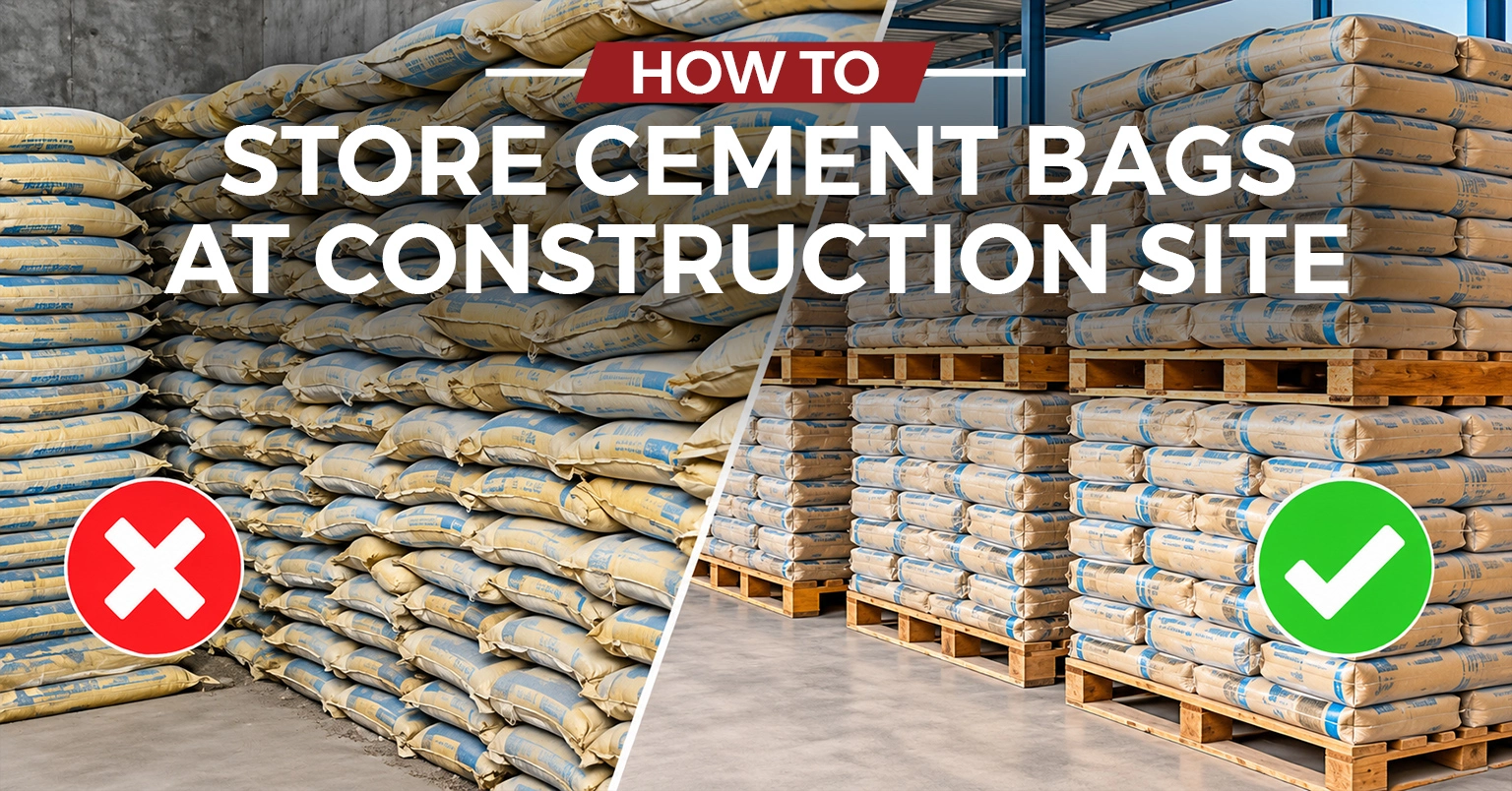
Introduction
How to Store Cement Bags at Construction Site is an important question for anyone involved in building a house, villa, apartment or commercial structure. Cement may arrive at the site in strong, sealed bags, but that does not mean it can be left anywhere until the mason needs it. Cement is moisture-sensitive, and exposure to damp floors, leaking roofs, rain, humid air or careless handling can affect its condition before it ever reaches the concrete or mortar mix.
For a homeowner, this may look like a simple storage issue. For a construction team, however, it is part of material quality control. A few damaged bags may not appear significant, but repeated wastage throughout a project can increase costs and create unnecessary material-management problems. Proper storage also helps the site team identify old stock, damaged bags and different cement batches more easily.
This becomes even more important for people constructing homes from outside India. An NRI homeowner may not be present every day to check whether cement bags are sitting directly on the floor, whether rainwater is entering the storage room or whether older bags are being consumed first. A well-organised site team therefore needs a clear storage system and regular monitoring process.
Whether you are constructing a compact independent home or one of the larger best villa projects in Chennai, understanding basic cement storage practices can help you ask the right questions and monitor your project with greater confidence.
AI Overview
Cement bags should be stored in a dry, leak-proof and weather-protected room, preferably on a raised platform rather than directly on the floor. Keep the bags away from walls, water sources and direct exposure to rain or atmospheric moisture. Stack bags safely, keep different cement types and batches separated, label delivery dates, and follow the first-in, first-out (FIFO) method so older cement is used before newer stock.
During the rainy season, additional protection is necessary. Use waterproof tarpaulins or suitable covers without trapping moisture around the bags, inspect the storage area regularly for roof or floor seepage, and avoid keeping damaged or damp bags with good stock. Cement that has formed hard lumps or has clearly been affected by moisture should not simply be assumed to be usable.
For a villa construction project, especially when the owner is living overseas, proper cement storage is one of the small site-management practices that can make a significant difference to material wastage, construction quality and project control.
Why Is Proper Cement Storage Important?
Cement is a key binding material used in concrete, mortar, plastering, masonry and several other construction activities. Its performance depends not only on the quality of the product when purchased but also on how it is handled before use.
The biggest concern during storage is moisture.
Cement can react with moisture before it is intentionally mixed with water. When moisture reaches the cement inside a bag, partial hydration can begin. This may lead to lumps, hardening and deterioration of the material. Industry guidance commonly recommends protecting cement from atmospheric moisture and using stock within a reasonable period rather than allowing bags to remain stored indefinitely.
Poor storage can result in:
- Hardened or lumpy cement
- Material wastage
- Damaged bags
- Difficulty in batching
- Confusion between different cement batches
- Higher construction costs
- Poor inventory control
- Potential quality issues if unsuitable material is used
The purpose of proper storage is therefore simple: protect the cement from the moment it arrives at the site until the moment it is used.
Choose a Dry and Weather-Protected Storage Area
The first step in learning How to Store Cement Bags at Construction Site is choosing the right storage location.
Ideally, cement should be stored inside a dedicated, weatherproof storage room or godown. The room should protect the bags from rain, groundwater, seepage, condensation and excessive atmospheric moisture.
Before bringing cement into the room, inspect:
- The roof for leaks
- Walls for damp patches
- Floor for water seepage
- Doors for gaps
- Drainage around the building
- Nearby plumbing or water storage
- General ventilation and humidity conditions
A newly constructed room should also be sufficiently dry before it is used for cement storage. Simply having four walls and a roof does not automatically make a space suitable for storing cement.
The storage room should also be organised so workers can easily inspect and remove bags without disturbing the entire stack.
Never Keep Cement Bags Directly on the Ground
One of the most common mistakes at construction sites is placing cement bags directly on the floor.
Even when a floor appears dry, moisture can reach bags from the ground or through small areas of seepage. During monsoon conditions, this risk becomes more significant.
Use a raised platform made from suitable, stable materials such as:
- Wooden pallets
- Strong timber sleepers
- Suitable raised platforms
- Other approved moisture-resistant arrangements
The objective is to create a physical separation between the cement bags and the floor.
Some construction guidance recommends keeping cement stacks elevated and away from external walls. References discussing IS 4082 site-storage practices commonly cite a raised platform and approximately 600 mm clearance from walls for cement storage.
The exact arrangement should be adapted to the site conditions and applicable project specifications.
Keep Cement Bags Away From Walls
A cement bag should not be pushed tightly against a damp or external wall.
Walls can transmit moisture, particularly during rainy weather or where there is seepage from the outside. Leaving an appropriate clearance also makes it easier for workers to inspect the bags and identify signs of dampness.
A practical site arrangement should provide sufficient space around the stack for:
- Inspection
- Cleaning
- Material movement
- Moisture monitoring
- Safe access
Guidance from major cement manufacturers recommends keeping cement bags away from walls and other moisture sources, while references to IS 4082 commonly use a 600 mm wall clearance as a storage recommendation.
Protect Cement From Rainwater
Rain is one of the biggest risks for cement storage at an active construction site.
This is particularly relevant in cities and regions where construction continues through the monsoon. A storage room may have a roof, but bags can still be affected by:
- Roof leakage
- Open doors
- Broken windows
- Water entering from the floor
- Splashing rainwater
- Poor drainage around the storage area
If temporary outdoor storage becomes unavoidable, the cement must be protected with a proper waterproof arrangement. Tarpaulin or suitable waterproof covers can provide additional protection, but the bags should still be elevated above the ground.
Do not assume that covering a pile of cement with one plastic sheet makes outdoor storage safe.
The entire arrangement needs to protect the bags from rain and ground moisture.
Rainy-season storage guidance from cement manufacturers similarly recommends elevated storage and waterproof protection.
Stack Cement Bags Correctly
Cement bags should be stacked in a stable and organised manner.
A careless pile can topple, damage bags and make stock rotation difficult. A properly arranged stack is easier to count, inspect and access.
Construction guidance varies slightly on maximum stack height depending on the storage conditions and reference being followed. UltraTech, for example, advises not exceeding 15 bags in its site-storage guidance, while references to IS 4082 commonly recommend 10 bags for ordinary storage conditions.
For a project site, the safest approach is to follow the applicable project specification, engineer’s instructions and relevant standard rather than treating one number as universal.
Bags should be arranged neatly and securely, with stacks kept stable.
Avoid creating excessively tall piles simply to save floor space.
Arrange Bags in an Interlocking Pattern
Cement bags can be arranged in an alternating or cross-layer pattern to improve stack stability.
For example, one layer may be arranged in one direction and the next layer in another direction. This helps create a more stable stack and reduces the risk of the pile shifting.
The purpose is not to create a decorative arrangement. It is a simple material-handling technique that helps maintain an organised stack.
The storage team should also make sure that:
- Bags are not leaning dangerously
- Bags are not damaged during stacking
- Access paths remain clear
- Stacks are easy to count
- Older stock can be removed without collapsing the pile
Follow the First-In, First-Out Method
A construction site may receive cement several times during a project.
If new bags are simply placed in front of old bags, the older stock may remain untouched for weeks or months.
That is why the First-In, First-Out (FIFO) system is useful.
The basic principle is simple:
The cement received first should normally be used first.
When a new delivery arrives:
- Record the delivery date.
- Check the bags for damage.
- Identify the batch where applicable.
- Place the new stock behind or separately from older stock.
- Mark the older stock clearly.
- Use older acceptable stock first.
FIFO is widely recommended in cement-storage guidance because cement quality can deteriorate with prolonged storage, particularly when storage conditions are poor.
This is especially useful for large villa projects where material deliveries occur over several stages.
Label Cement Bags and Storage Batches
Good site management depends on traceability.
When cement arrives, the site team should record useful information such as:
- Delivery date
- Cement manufacturer
- Cement type
- Batch information where available
- Number of bags received
- Number of damaged bags
- Storage location
This does not need to become complicated paperwork.
A simple register or digital spreadsheet can help the site team understand how much cement is available and which batch should be used next.
For an NRI homeowner, this information can also be useful when receiving regular construction updates remotely.
Instead of asking only, “Has the cement arrived?”, the homeowner can ask:
“When was the latest cement delivery received, how many bags are currently in stock, and how are the older bags being rotated?”
That is a much more useful construction-management question.
Keep Different Cement Types and Batches Separate
Different cement products should not be mixed together simply because they are all called cement.
Depending on the project requirements, the site may receive different cement types or products for specific applications.
Keep different materials clearly separated and labelled.
For example:
- Cement type A — separate stack
- Cement type B — separate stack
- Older batch — clearly identified
- Newer batch — clearly identified
- Damaged bags — isolated for inspection
Separate storage reduces the chance of workers picking the wrong material during a busy construction day.
It also makes inventory checking easier.
Handle Cement Bags Carefully
Storage does not end with stacking.
Handling practices also influence the condition of the bags.
Workers should avoid:
- Throwing cement bags
- Dragging bags over rough surfaces
- Dropping bags from a height
- Puncturing bags
- Using hooks that can tear the packaging
- Leaving damaged bags exposed
A small hole in the packaging can allow moisture to reach the cement.
Recent cement-storage guidance also highlights careful handling, inspection at delivery and avoiding hooks that can damage bags.
Good handling is particularly important when cement is moved repeatedly between the store and mixing area.
Inspect Cement Bags When They Arrive
Do not wait until the cement is required to discover that some bags were damaged during transportation.
Inspect the delivery when it reaches the site.
Look for:
- Torn bags
- Wet patches
- Damp packaging
- Hardened areas
- Unusual lumps
- Missing or unclear identification
- Contamination
Separate damaged bags from good stock.
If there is uncertainty about whether a damaged or aged cement product is suitable for use, it should be evaluated according to the applicable quality-control procedure rather than being used automatically.
This simple inspection can prevent a small delivery problem from becoming a larger construction problem.
Do Not Store Cement Near Water or Chemicals
Cement storage areas should be separated from materials that can introduce moisture or contamination.
Avoid storing cement beside:
- Water tanks
- Water drums
- Paint
- Chemicals
- Fuel
- Solvents
- Leaking plumbing
- Wet construction materials
If a pipe bursts or a container leaks, cement bags stored nearby can be damaged quickly.
A dedicated storage area is therefore preferable to using a random corner of the construction site.
Check the Storage Room Regularly
A storage room that was dry last week may not remain dry this week.
Construction sites change quickly.
New walls are constructed, plumbing is installed, roofs are modified, temporary openings appear and rainwater paths can change.
The site supervisor should periodically inspect:
- Roof condition
- Wall dampness
- Floor moisture
- Water leakage
- Bag condition
- Stack stability
- Storage cleanliness
- Pest or contamination issues
- Access paths
Regular inspection is especially important during the monsoon.
Keep the Storage Area Clean
Housekeeping may sound unrelated to cement quality, but it matters.
A dirty storage area makes it harder to identify water leaks, damaged bags and stock movement.
The floor around the storage platform should be kept clean and dry.
Do not allow:
- Standing water
- Construction debris
- Loose packaging
- Broken timber
- Tools blocking access
- Unnecessary materials around cement stacks
A clean storage area makes inspection and inventory management easier.
Do Not Buy More Cement Than the Project Can Properly Store
Bulk purchasing may appear attractive because it can reduce the number of deliveries. But a construction site has limited storage capacity.
Buying a large quantity without a suitable storage area can create unnecessary risk.
Before ordering cement, consider:
- Current stock
- Planned construction activities
- Storage capacity
- Expected consumption
- Weather conditions
- Delivery schedule
- Project stage
The goal is not to keep the maximum possible quantity on site.
The goal is to keep the right quantity in good condition.
How Long Can Cement Be Stored?
One of the most common questions homeowners ask is, “How long can I keep cement?”
There is no single practical answer that applies regardless of the product, packaging, environmental conditions and storage method.
Cement quality can deteriorate over time, particularly when exposed to moisture. Several Indian construction guidance sources recommend using cement relatively soon after purchase and applying quality checks to older stock rather than assuming that age alone determines suitability. ACC, for example, advises using cement within three months and testing older cement before use.
Therefore, instead of focusing only on a calendar number, monitor:
- Date of manufacture where available
- Date of purchase
- Storage conditions
- Packaging condition
- Presence of lumps
- Project specifications
- Manufacturer recommendations
- Quality-control requirements
Older cement should not automatically be used simply because it is still in a sealed-looking bag.
What Happens When Cement Absorbs Moisture?
Cement reacts chemically with water.
That reaction is desirable when cement is intentionally mixed during construction. It becomes a problem when moisture reaches the cement prematurely.
Moisture exposure may result in:
- Lumps
- Partial hardening
- Reduced workability
- Material wastage
- Possible loss of performance
A bag containing small soft lumps is not necessarily equivalent to a bag containing hard, moisture-affected cement. The condition should be assessed according to the applicable quality-control procedure.
If cement has become severely hardened due to moisture exposure, it should not simply be mixed into structural concrete because the bag is already paid for.
How to Store Cement During the Rainy Season
Rainy-season storage requires additional attention.
Before heavy rain begins, the construction team should inspect the cement room.
Rainy-season checklist
- Check roof leaks.
- Check wall seepage.
- Keep bags above floor level.
- Maintain suitable wall clearance.
- Keep waterproof covers available.
- Check drainage around the storage room.
- Keep doors properly closed when appropriate.
- Inspect bags after heavy rainfall.
- Remove wet or damaged bags from good stock.
- Avoid unnecessary outdoor storage.
A recent 2026 cement-storage guide specifically highlights raised pallets, waterproof tarpaulin protection and additional care during rain.
For construction projects in Chennai and other parts of Tamil Nadu, seasonal moisture management should be treated as part of normal site planning rather than something done only after the first major rain.
Cement Storage for Villa Construction
Cement storage becomes particularly important in villa construction because the project usually progresses through several stages.
Cement may be needed for:
- Foundation work
- Footings
- Columns
- Beams
- Slabs
- Blockwork
- Plastering
- Flooring
- External works
- Compound walls
- Other finishing-related applications
Each stage can have different material requirements.
For homeowners looking at villas in Chennai, the construction process can extend over a significant period. Material deliveries should therefore be coordinated with the construction schedule instead of simply accumulating large quantities on site.
The same principle applies to villas in Madurai and villas in Coimbatore, where site conditions, weather and project schedules can vary.
A professional developer or contractor should have a material-management process that considers both construction requirements and storage capacity.
Why Cement Storage Matters to NRI Homeowners
For an NRI building a home in India, cement storage is not just a technical construction detail.
It is a visibility issue.
If you live in Dubai, Singapore, Qatar, the USA or another country, you may not be able to visit the site every week. You may depend on:
- Site photographs
- Video updates
- Progress reports
- Quantity updates
- Engineer inspections
- Contractor communication
- Project dashboards
- Scheduled site visits by representatives
When you are not physically present, basic material controls become more important.
A homeowner can ask for photographs showing:
- Cement bags on raised platforms.
- Storage-room condition.
- Stack arrangement.
- Delivery dates.
- Older stock being used first.
- Protection during rainy weather.
- Any damaged bags separated from usable stock.
These simple checks provide much better visibility than relying only on a general statement that “materials are available.”
How VNCT Global Can Support NRI Homeowners
For an NRI homeowner, choosing a construction or villa development partner is about more than selecting a floor plan.
The bigger concern is often:
“Who will take care of my property while I am not in India?”
This is where a structured developer-led approach can provide confidence.
VNCT Global focuses on villa developments and property experiences designed for homeowners who want a more organised approach to residential construction and development.
For NRI customers, communication and transparency can be especially important. Instead of expecting the homeowner to personally monitor every construction activity, the project team can provide updates and coordinate the different stages of development.
When discussing projects such as Brookside Residences, Palm Shore, Palm Beach, Creek Residences, Park Villas, and Ocean Drive Villas, the broader objective is to give buyers a clearer understanding of the property, development process and support available.
For someone researching the best villa developers in India, the quality of the final home is only one part of the decision. Project execution, communication, construction supervision, material management and customer support also deserve attention.
What NRIs Should Ask Before Buying a Villa
If you are an NRI considering a villa, do not limit your questions to price and built-up area.
Ask practical questions about construction management.
Questions worth asking
1. Who supervises construction?
Find out whether an internal project team, engineer or contractor supervises the work.
2. How are construction materials stored?
Ask whether materials such as cement and steel are protected from weather exposure.
3. How are material deliveries recorded?
A delivery register can improve accountability.
4. How frequently are site updates provided?
Understand whether updates are weekly, fortnightly or provided at key milestones.
5. Who can the NRI contact when there is a concern?
A clear communication channel is extremely valuable when the owner is abroad.
6. Are construction stages documented?
Photos, videos and progress records can help an NRI understand what is happening without visiting the site constantly.
7. How are quality checks handled?
Ask about testing, inspections and engineer supervision.
These questions can help separate a professionally managed project from one where the buyer is expected to coordinate everything personally.
Best Villa Developers in India: What Should Buyers Look For?
When searching online for the best villa devlopers in india, buyers often compare location, amenities, pricing and project appearance.
Those factors matter, but construction management deserves equal attention.
A serious buyer should evaluate:
- Developer track record
- Project approvals
- Construction quality
- Location
- Project specifications
- Material management
- Engineering supervision
- Customer communication
- Handover process
- After-sales support
- NRI assistance
The phrase best villa devlopers in india should not simply mean the company with the most attractive brochure. For an NRI, the better question is whether the developer can provide a reliable end-to-end property experience.
Likewise, people searching for the largest villa devlopers in india should look beyond company size. A large organisation may have an extensive portfolio, but buyers should still examine how a particular project is being managed.
Largest Villa Developers in India: Does Size Matter?
Searching for the largest villa devlopers in india can be a useful starting point, but size alone should not determine your purchase.
A villa is a long-term investment.
A buyer should also look at:
- Project-specific execution
- Construction specifications
- Quality-control systems
- Site management
- Customer service
- Legal documentation
- Location advantages
- Community planning
- Maintenance arrangements
For NRIs, responsiveness can be just as important as portfolio size.
If a homeowner is thousands of kilometres away, the ability to communicate clearly and receive reliable project information can make the entire buying experience easier.
Best Villa Developers in India and NRI Support
The term best villa devlopers in india becomes more meaningful when a developer understands the practical needs of homeowners who cannot regularly visit the site.
NRI support may include:
- Remote communication
- Digital documentation
- Project updates
- Site photographs
- Video walkthroughs
- Dedicated customer support
- Assistance with property-related coordination
- Updates on construction milestones
The exact services available will vary by project and agreement, so buyers should always confirm the scope of support before making a purchase.
For people researching best villa projects in Chennai, the same principle applies: don’t evaluate only the finished elevation. Consider how the project is managed before completion.
Cement Storage and Construction Quality Are Connected
It is easy to think of cement storage as a housekeeping activity.
It is more than that.
Construction quality depends on a chain of decisions:
Material selection → Material delivery → Storage → Handling → Testing → Batching → Mixing → Placement → Curing → Inspection
If material storage is neglected, one link in that chain becomes weaker.
This does not mean that poor cement storage automatically causes structural failure. Construction performance depends on many factors, including material quality, mix design, workmanship, curing and engineering practices.
But protecting cement before use is a sensible and necessary part of construction quality management.
Cement Storage Checklist for Construction Sites
A simple checklist can make site supervision much easier.
Before delivery
- Confirm adequate storage space.
- Check the roof.
- Check the floor.
- Prepare raised platforms.
- Clear access paths.
- Check drainage.
During delivery
- Count the bags.
- Inspect packaging.
- Record delivery information.
- Separate damaged bags.
- Identify cement type and batch.
During storage
- Keep bags elevated.
- Maintain suitable wall clearance.
- Protect from rain.
- Keep different batches organised.
- Maintain stable stacks.
- Follow FIFO.
During regular inspection
- Check for dampness.
- Check for lumps.
- Inspect roof and walls.
- Check platform condition.
- Review stock records.
- Remove damaged material from good stock.
This simple routine can prevent many avoidable storage problems.
How Homeowners Can Monitor Cement Storage Remotely
If you are an NRI, you do not need to become a construction engineer to monitor basic material practices.
Ask your project team for occasional photographs or videos showing:
- Cement storage room
- Raised platforms
- Stack arrangement
- Delivery labels
- Material register
- Rain protection
- General site housekeeping
You can also ask questions such as:
“Are the cement bags stored above the floor?”
“Are older bags being used first?”
“Were any bags damaged during the latest delivery?”
“Has the storage area been checked for water leakage?”
These questions are simple, but they demonstrate that the project is being monitored.
Cement Storage for Projects in Chennai
Chennai’s coastal location and humid conditions make moisture management an important consideration for construction sites.
For homeowners considering villas in Chennai, material storage should be discussed as part of the overall construction-management process.
During rainy periods, site teams should pay particular attention to:
- Roof leaks
- Groundwater
- Surface runoff
- Humidity
- Open storage areas
- Water accumulation
A well-planned cement store reduces unnecessary exposure.
This is one reason material storage should be planned before construction materials begin arriving in large quantities.
Cement Storage for Villas in Madurai
For buyers exploring villas in Madurai, cement storage remains an important construction-management consideration even though the local environmental conditions may differ from Chennai.
The basic principles remain the same:
Keep cement dry. Keep it elevated. Keep it organised. Keep it protected.
The storage method should be adjusted according to the project location, building design, construction schedule and weather conditions.
Cement Storage for Villas in Coimbatore
For people considering villas in Coimbatore, proper material management should also be part of the project evaluation.
The question is not simply whether cement is delivered to the site.
The better question is:
How is that cement protected before it is used?
A professional site-management system should have a defined approach for receiving, storing, tracking and consuming construction materials.
What Makes a Well-Managed Villa Project?
A well-managed villa project is not defined only by a beautiful entrance, landscaped garden or impressive elevation.
Behind the finished appearance is a sequence of construction activities.
These include:
- Site preparation
- Foundation work
- Structural construction
- Waterproofing
- Masonry
- Plastering
- Electrical work
- Plumbing
- Flooring
- Painting
- External development
- Quality inspections
Material management supports every one of these stages.
For people comparing the best villa projects in Coimbatore, best villa projects in Madurai, or best villa projects in Chennai, construction-management practices can be an important part of due diligence.
Why Material Wastage Matters
Wasted cement is not simply the cost of one bag.
The real cost can include:
- Purchase cost
- Transportation
- Loading
- Unloading
- Labour
- Storage space
- Replacement material
- Disposal
- Project delays
If several bags are damaged repeatedly, the financial impact can become noticeable.
Good storage therefore supports both quality control and cost control.
For developers, contractors and homeowners, reducing avoidable wastage is simply good project management.
Cement Storage and Site Safety
Storage also has a safety dimension.
Cement bags are heavy. Poorly arranged stacks can fall or become difficult to remove safely.
Workers should have adequate access around storage areas and should follow appropriate manual-handling procedures.
The site should also provide suitable personal protective equipment for cement handling, particularly where workers may be exposed to cement dust.
Recent construction-storage guidance highlights safe handling, appropriate lifting practices, eye protection, gloves, safety footwear and dust protection as relevant precautions.
The exact safety requirements should follow the project’s health and safety plan.
Should Cement Bags Be Covered With Plastic?
Plastic sheets or tarpaulins can provide additional protection, particularly during rainy conditions.
However, the primary storage arrangement should already be weatherproof.
A cover should not be treated as a substitute for:
- A leak-proof roof
- Raised storage
- Proper drainage
- Wall clearance
- Good housekeeping
If bags are covered, the cover should be arranged appropriately so that rainwater cannot collect and flow onto the cement stack.
The storage method should prevent moisture from reaching the bags rather than merely hiding the bags under a sheet.
What Should You Do With a Wet Cement Bag?
If a cement bag becomes wet, do not immediately add it to good stock.
Separate it from unaffected material.
Then assess:
- How much of the bag was exposed?
- Is the packaging damaged?
- Are there visible lumps?
- Has the cement hardened?
- When did the exposure occur?
- What does the project quality procedure require?
Cement that has hardened because of moisture should not be treated as normal fresh cement.
For structural work, material suitability should be determined through the appropriate technical and quality-control process.
How Cement Storage Supports Better Project Management
A good storage system creates a simple chain of accountability:
Received → Inspected → Recorded → Stored → Monitored → Issued → Used
This makes it easier to identify where material was lost or damaged.
For large projects, the same approach can be extended to other construction materials such as:
- Reinforcement steel
- Blocks
- Tiles
- Paint
- Plumbing materials
- Electrical materials
- Waterproofing products
Material management is therefore not a separate activity from project management. It is part of it.
VNCT Global and the Importance of Construction Transparency
For a homeowner, especially an NRI, buying a villa should provide more than an attractive property brochure.
The buyer should feel confident that there is a process behind the project.
VNCT Global’s villa-focused developments, including Brookside Residences, Palm Shore, Palm Beach, Creek Residences, Park Villas, and Ocean Drive Villas, can be evaluated not only from their location and design but also from the broader project experience offered to buyers.
For NRI customers, support can be particularly valuable because the homeowner may not be able to personally visit the property during every stage.
If you are considering a villa purchase, ask about:
- Construction updates
- Project coordination
- Site supervision
- Documentation
- Communication channels
- Handover process
- NRI support
If you want to understand the available project options or discuss your requirements, you can contact us VNCT Global through the appropriate official communication channel.
What NRIs Should Check During a Site Visit
If you are visiting India for a short period during your villa construction, use the opportunity to look at the actual site-management process.
You do not need to inspect every bag individually.
Instead, observe:
- Is cement stored inside?
- Are bags raised from the floor?
- Are stacks stable?
- Are different batches separated?
- Is the room clean?
- Is there any visible dampness?
- Are older bags accessible?
- Is there a material register?
These observations can tell you a surprising amount about how seriously the project team treats material management.
Final Thoughts
How to Store Cement Bags at Construction Site is a straightforward topic, but it has a direct connection with construction quality, material wastage, safety and project management.
The most important principle is simple: keep cement dry, protected, organised and traceable until it is ready for use.
Store bags on a raised platform, protect them from rain and moisture, keep suitable clearance from walls, arrange stable stacks, separate different batches, inspect deliveries and follow FIFO. During the rainy season, increase inspections and make sure the storage room, roof and drainage system are ready for wet conditions.
For homeowners, these practices are useful because they provide a simple way to understand how professionally a construction site is being managed.
For NRI homeowners in particular, material storage can become part of a broader project-monitoring system. You may not be physically present every day, but you can still ask meaningful questions, request progress photographs and understand how your construction materials are being handled.
Whether you are comparing best villa projects in Chennai, best villa projects in Coimbatore, or best villa projects in Madurai, look beyond the brochure and elevation. Consider the construction process, site supervision, quality practices, communication and support available throughout the project.
A well-designed home deserves a well-managed construction process.
And sometimes, that process starts with something as basic as storing a cement bag correctly.
FAQs For Store Cement Bags at Construction Site
What is the best way to store cement bags at a construction site?
Store cement bags in a dry, weatherproof room on a raised platform. Keep them away from damp floors and walls, protect them from rain and moisture, stack them safely, and use older acceptable stock first.
Can cement bags be kept directly on the floor?
It is better to avoid direct floor contact. Use a raised platform or suitable pallets to reduce exposure to ground moisture.
How high can cement bags be stacked?
The recommended height can vary according to the applicable standard, project specification and storage conditions. References to IS 4082 commonly recommend a 10-bag stack, while UltraTech’s site guidance permits up to 15 bags under its stated conditions. Follow the project engineer’s requirements and applicable standards rather than using one number universally.
How far should cement bags be kept from walls?
A commonly referenced IS 4082 storage recommendation is approximately 600 mm from external walls. The actual project arrangement should follow the applicable specification and site conditions.
Can cement be stored outside?
Indoor, weatherproof storage is preferable. If temporary outdoor storage is unavoidable, the bags need proper elevation and full protection from rain and moisture.
Why does cement become lumpy?
Cement can develop lumps when it is exposed to moisture and begins reacting before intended use. Severe moisture exposure can cause hardening and make the material unsuitable.
Should old cement be used first?
Yes. The first-in, first-out method helps prevent older stock from remaining unused for too long.
How long can cement be stored?
Storage life depends on the product, packaging, environmental conditions and storage quality. Cement should not be kept indefinitely. Older material should be assessed according to manufacturer recommendations and project quality-control requirements.
How should cement be stored during the rainy season?
Keep bags inside a leak-proof room, raise them above the floor, check for wall and roof seepage, maintain suitable covers where necessary and inspect the storage area after heavy rainfall.
Can different cement types be stored together?
Different cement types and batches should be clearly separated and labelled to avoid accidental mixing or incorrect use.