AI Overview
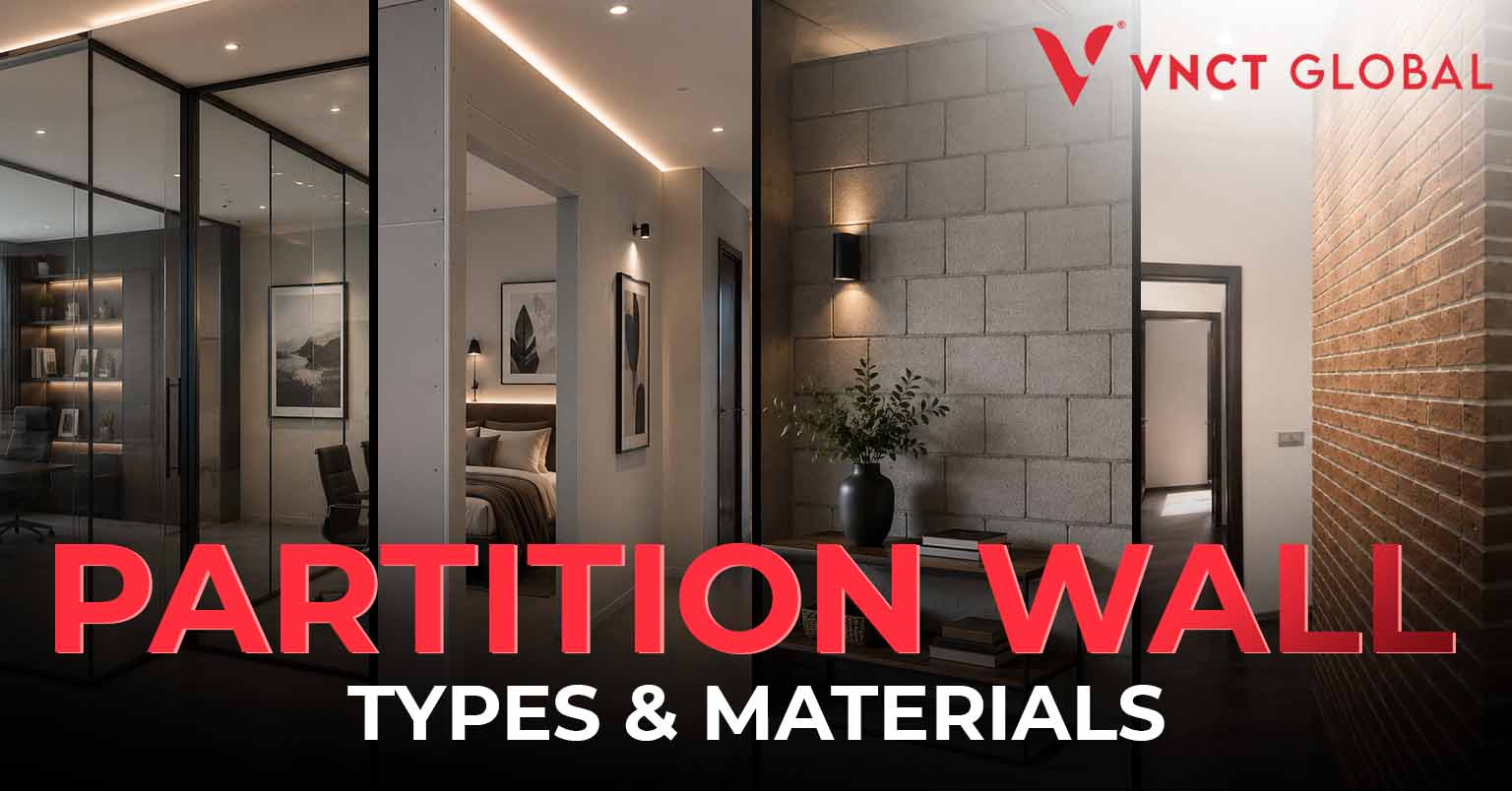
Partition Wall Types & Materials vary according to the room, purpose, design, privacy requirements, durability, budget and construction method. Common options include brick, concrete blocks, AAC blocks, gypsum boards, glass, wood, metal, fibre-cement boards and modular partitions. Brick and block partitions are generally preferred when a more permanent wall is required, while gypsum, glass, wood and modular systems can offer faster installation and greater design flexibility. The right partition should provide the required privacy, acoustic performance, durability and appearance without unnecessarily adding weight or reducing usable space.
Introduction
Partition Wall Types & Materials play an important role in deciding how the spaces inside a home look, feel and function. A large open room may look spacious, but dividing it into clearly defined areas can make everyday living much more comfortable. A partition can separate a living room from a dining area, create privacy for a bedroom, divide a kitchen from the dining space or create a dedicated workspace without completely changing the building structure.
Unlike an external wall, a typical internal partition is primarily intended to divide spaces rather than carry the main structural loads of a building. The exact structural role, however, depends on the building system and the way the wall has been designed.
Today, homeowners have many choices. Traditional brick walls remain popular, but lightweight options such as gypsum boards, AAC blocks, fibre-cement boards, glass and modular systems are increasingly used. Decorative wooden slats, metal frames, open shelves and glass screens can also act as partitions while allowing light and airflow to move between spaces.
For villa construction, the choice becomes even more important. A premium villa may have large open-plan living spaces, double-height areas, home offices, entertainment rooms and flexible bedrooms. The partition material needs to complement both the architecture and the practical requirements of the family.
This guide explains the major partition wall types, materials, applications, advantages, limitations and selection factors. It also covers important considerations for NRIs planning or purchasing a villa in India.
What Is a Partition Wall?
A partition wall is an internal wall or dividing element used to separate one space from another.
For example, a partition could divide:
- Living room and dining area
- Bedroom and dressing area
- Kitchen and utility area
- Bedroom and home office
- Living room and foyer
- Study area and family room
- Bathroom and dry area
Partition walls can be permanent or relatively easy to modify depending on the construction system.
A traditional masonry partition may remain in place for decades, while a lightweight modular partition can potentially be dismantled and relocated when the interior layout changes.
Current residential guidance commonly categorises partition walls according to materials and whether the partition is fixed or more flexible.
Are Partition Walls Load-Bearing?
This is one of the first things homeowners should understand.
A partition wall is commonly designed as a non-load-bearing wall, meaning its primary purpose is to divide internal spaces rather than support the building’s main structural loads.
However, not every internal wall in every building is automatically non-load-bearing.
In a load-bearing building, some walls may contribute to the structural system. Removing or modifying such a wall without professional assessment can be dangerous.
Before removing an existing wall, always confirm:
- Whether it is load-bearing
- Whether services run through it
- Whether it supports any structural element
- Whether removing it affects fire separation
- Whether approval is required
For new construction, the architect and structural engineer should coordinate the wall layout before construction begins.
Major Partition Wall Types
Partition walls can be classified in several ways, including construction material, permanence and application.
The most common types include:
- Brick partition walls
- Concrete block partition walls
- AAC block partition walls
- Gypsum board partitions
- Glass partitions
- Wooden partitions
- Metal frame partitions
- Fibre-cement board partitions
- Modular partitions
- Decorative open partitions
Let’s look at each one.
1. Brick Partition Wall
Brick is one of the most familiar partition materials in Indian construction.
A brick partition is built using masonry units and mortar and can provide a solid, permanent division between rooms.
Brick partitions are commonly used for:
Advantages
- Durable
- Familiar construction method
- Good impact resistance
- Suitable for permanent layouts
- Can accommodate many types of finishes
- Good thermal mass
Limitations
- Heavier than lightweight systems
- Requires masonry work
- Takes longer to construct
- Adds load to the structure
- Generates construction debris
- Layout changes can be difficult after completion
In many residential projects, internal walls are specified around 4 to 4.5 inches thick depending on the masonry system and project design. Actual dimensions should always follow the approved drawings and material specifications. Current project specifications in Chennai show the continued use of 4.5-inch internal partition walls using different masonry materials.
2. Concrete Block Partition Wall
Concrete blocks can be used to construct internal partition walls.
They are generally durable and provide a solid wall surface suitable for plastering and painting.
Benefits
- Strong and durable
- Good impact resistance
- Suitable for permanent walls
- Good fire performance depending on the system
- Can provide good acoustic separation
Drawbacks
- Heavier than many lightweight alternatives
- Requires masonry workmanship
- May require plastering
- Can take longer to construct than dry partition systems
Concrete blocks can be suitable where durability and robustness are more important than rapid installation.
3. AAC Block Partition Wall
Autoclaved Aerated Concrete, or AAC, blocks are lightweight masonry units widely used in modern construction.
Their lower density can help reduce the dead load compared with conventional masonry.
AAC blocks can be used for internal and external walls depending on the building design and specifications.
Advantages
- Lightweight
- Faster installation than some traditional masonry systems
- Easier handling
- Good thermal insulation
- Suitable for modern residential construction
Limitations
- Requires appropriate installation techniques
- Fixing heavy items needs proper anchors
- Surface finishing must follow the manufacturer’s recommendations
- Impact resistance can differ from conventional brickwork
AAC can be an attractive option when reducing wall weight is an important consideration.
4. Gypsum Board Partition
Gypsum board partitions are lightweight dry-wall systems generally constructed using a metal or other framing system with gypsum boards fixed to the frame.
They are particularly useful for interior spaces where speed, flexibility and a clean finish are priorities.
Gypsum drywall is widely used as a room divider because it is lightweight and relatively cost-effective for interior partitioning. Different boards can also provide specialised moisture, fire or acoustic performance.
Advantages
- Lightweight
- Fast installation
- Less wet work
- Smooth finish
- Easy to route services within the cavity
- Flexible layout
- Suitable for false-wall applications
Limitations
- Standard boards can be vulnerable to moisture
- Heavy fixtures require suitable reinforcement
- Impact resistance depends on the system
- Poor installation can result in cracks at joints
For bathrooms or humid locations, the appropriate moisture-resistant board and waterproofing system should be selected rather than using a standard board without consideration of the environment.
5. Glass Partition Wall
Glass partitions are popular in contemporary homes because they separate spaces without making them feel completely enclosed.
A glass partition can be:
- Clear
- Frosted
- Tinted
- Textured
- Laminated
- Framed
- Frameless
Glass is especially useful where natural light needs to pass from one room to another.
Common applications
- Living room
- Dining area
- Home office
- Kitchen
- Foyer
- Walk-in wardrobe
- Bathroom
Advantages
- Allows natural light
- Creates a modern appearance
- Makes spaces appear larger
- Visually lightweight
- Can provide privacy with frosted or textured glass
Limitations
- Privacy depends on glass selection
- Requires careful installation
- Can show fingerprints and dust
- Safety glass should be specified appropriately
- Acoustic performance varies by glass and framing system
Glass partitions are particularly popular in modern interiors because they can divide a space while maintaining visual continuity.
6. Wooden Partition
Wooden partitions can bring warmth and texture into an interior.
They can be constructed as:
- Solid wood panels
- Wooden slats
- Decorative screens
- Veneered panels
- Timber frames
- Open shelving systems
Wooden slat partitions are particularly popular in contemporary living rooms because they divide spaces without completely blocking light or airflow.
Advantages
- Warm appearance
- Highly customisable
- Suitable for decorative interiors
- Can combine partition and storage
- Available in many finishes
Limitations
- Requires moisture protection
- Termite protection may be necessary
- Maintenance depends on the finish
- Solid wood can be expensive
- Fire performance varies by material and treatment
For premium villas, wood can be combined with glass, metal or stone finishes to create a more distinctive interior.
7. Metal Partition
Metal partitions can use aluminium, steel or other metal framing systems.
They are often combined with glass, wood, mesh or decorative panels.
Advantages
- Modern appearance
- Strong framing
- Lightweight compared with masonry
- Highly customisable
- Suitable for contemporary designs
Limitations
- Finish quality is important
- Steel may require corrosion protection
- Poor detailing can look industrial rather than residential
- Acoustic performance depends on the complete partition system
A black metal frame with clear or frosted glass, for example, can create a strong visual separation while maintaining natural light.
8. Fibre-Cement Board Partition
Fibre-cement boards can be used in partition systems where a durable sheet material is required.
They are generally more resistant to moisture than standard gypsum boards, although the complete wall system still needs appropriate detailing.
They can be useful for:
- Utility areas
- Service spaces
- Semi-wet areas
- Internal partitions
- Lightweight construction
The exact board specification should be selected according to the manufacturer’s technical data and the environment in which it will be installed.
9. Modular Partition
Modular partitions are designed for flexibility.
Instead of constructing a permanent masonry wall, individual panels or frames can be installed and later modified.
They are commonly used in:
- Home offices
- Commercial spaces
- Temporary rooms
- Flexible work areas
- Renovation projects
For homeowners who expect their space requirements to change, modular partitions can offer a practical alternative.
10. Decorative Open Partition
Not every partition needs to be a full-height wall.
Open partitions can be created using:
- Wooden slats
- Metal screens
- Open shelving
- CNC-cut panels
- Laser-cut metal
- Glass blocks
- Decorative screens
- Plants and planters
These options provide visual separation without completely dividing the room.
They work particularly well in open-plan living spaces.
Partition Wall Materials – Which One Should You Choose?
There is no single material that is best for every room.
The right choice depends on what you expect the partition to do.
| Material | Best suited for | Main advantage | Main consideration |
| Brick | Permanent rooms | Durable | Heavy |
| Concrete block | Permanent partitions | Strong | Adds weight |
| AAC block | Modern masonry | Lightweight | Requires suitable fixing |
| Gypsum board | Interior rooms | Fast installation | Moisture/detailing |
| Glass | Living/office spaces | Natural light | Privacy |
| Wood | Decorative partitions | Warm appearance | Maintenance |
| Metal | Contemporary interiors | Flexible design | Finish/corrosion |
| Fibre cement | Utility/semi-wet areas | Durable sheet system | Installation |
| Modular panels | Flexible layouts | Easy modification | System cost |
| Open screens | Decorative separation | Airflow/light | Limited privacy |
Factors to Consider Before Selecting a Partition
Choosing a partition should start with the purpose of the room rather than the appearance of the material.
1. Privacy
A bedroom partition requires more privacy than a living-room divider.
For bedrooms, solid masonry, gypsum or opaque panels may be preferable.
For living rooms, glass or open slats may work better.
2. Sound Insulation
If the partition separates:
- Bedroom and living room
- Home theatre and bedroom
- Children’s room and study
- Home office and living room
then acoustic performance becomes important.
A lightweight single-layer partition may not provide the same acoustic performance as a properly designed multi-layer system.
The complete assembly matters—not just the board or panel.
3. Moisture
Bathrooms, utility areas and kitchens can expose partitions to moisture.
Standard gypsum board may not be suitable for every wet application.
The board, framing, waterproofing, sealants and finish should all be considered together.
4. Fire Safety
Where fire resistance is important, the partition must be designed and tested as a complete system.
Fire-resistant boards alone do not automatically make every partition fire-rated.
The complete assembly, including framing, insulation, boards and joints, needs to meet the required specification.
5. Weight
Wall weight matters in multi-storey buildings.
A lightweight partition can reduce the dead load compared with heavier masonry.
This is one reason lightweight systems are increasingly considered in modern construction.
6. Future Changes
Ask yourself:
Will this wall still be required five or ten years from now?
If the answer is uncertain, a modular or lightweight system may offer more flexibility.
A permanent masonry wall is less convenient to modify later.
Partition Walls for Different Rooms
Living Room
Popular choices include:
- Wooden slats
- Glass
- Open shelves
- Decorative panels
- Metal screens
The goal is often visual separation rather than complete privacy.
Bedroom
Bedroom partitions generally require greater privacy.
Suitable options can include:
- Brick
- AAC blocks
- Gypsum boards
- Solid decorative panels
For dressing areas, frosted glass or timber screens can also work well.
Kitchen
Kitchen partitions need to consider:
- Moisture
- Heat
- Cleaning
- Odours
- Ventilation
Glass is often useful because it separates the kitchen while maintaining visibility.
Home Office
A home office requires privacy and acoustic control.
Gypsum partitions with suitable insulation or glass systems can work depending on the level of privacy required.
Bathroom
Bathrooms need moisture-resistant construction and proper waterproofing.
A partition should never be selected only for appearance.
The waterproofing system, substrate and finishing material all need to work together.
Partition Wall vs Room Divider
The terms are sometimes used interchangeably, but there is a practical difference.
A partition wall is generally more substantial and can be fixed permanently to the building.
A room divider can be more decorative or movable.
For example:
Partition wall: gypsum board wall between a bedroom and study.
Room divider: wooden slat screen separating living and dining areas.
The distinction is useful when planning future changes.
Partition Walls and Interior Design
A partition does not have to be boring.
It can become a major architectural feature.
For example:
Wood + Glass
Creates warmth while maintaining natural light.
Metal + Glass
Creates a contemporary industrial appearance.
Wood + Open Shelves
Combines storage with space division.
Stone Finish + Lighting
Creates a premium feature wall.
Slatted Wood
Provides privacy while maintaining airflow and visual connection.
Modern partition design trends increasingly focus on combining functionality with aesthetics rather than treating a partition as simply a wall.
Partition Walls and Construction Quality
When selecting among the best villa developers in India, buyers often focus on the elevation, amenities, flooring and kitchen finishes.
Those are important, but hidden construction decisions matter too.
The type of internal wall affects:
- Thermal performance
- Acoustic comfort
- Durability
- Interior flexibility
- Installation time
- Maintenance
- Future renovation
For a villa, the partition system should be coordinated with the structural, architectural, electrical and plumbing designs.
This is particularly important when selecting among best villa projects in Chennai, because a premium-looking interior still needs a well-coordinated construction system behind it.
Partition Walls for NRI Homebuyers
For NRIs, choosing a villa is often a long-term decision.
An NRI living in Dubai, Singapore, Qatar, the USA or another country may not be able to visit the construction site frequently.
This makes the specification of internal walls especially important.
Instead of asking only:
“What type of wall is being used?”
ask:
- What material is specified?
- What is the wall thickness?
- Is it load-bearing or non-load-bearing?
- What finish will be applied?
- What acoustic performance is expected?
- How are wet areas treated?
- How are electrical conduits installed?
- How are heavy fixtures supported?
- Can the wall be modified later?
These questions give an NRI a much clearer understanding of the property.
How VNCT GLOBAL Supports NRI Homebuyers
At VNCT GLOBAL, we understand that an NRI homeowner cannot always be physically present during every stage of construction.
A good remote-buying experience therefore requires clear communication and project coordination.
For NRI customers, project support can include clear updates regarding important construction milestones, project progress, specifications and coordination.
For internal partition work, homeowners can benefit from understanding:
- Which wall materials are specified
- Where different partition systems are used
- How interior layouts are progressing
- How design decisions affect the finished villa
- When important construction stages are completed
Progress photographs and videos can also help NRI homeowners understand what is happening on site without having to travel for every inspection.
This kind of communication is particularly valuable when a homeowner is planning a villa from overseas.
If you are an NRI exploring villa opportunities in India and want to understand the available projects and support, contact us VNCT GLOBAL for more information.
Partition Materials for Villas in Chennai
For villas in Chennai, partition selection needs to consider the local climate, building design and interior requirements.
For example:
- AAC blocks can be considered where lightweight masonry is preferred.
- Gypsum systems can be useful for dry internal areas.
- Glass can work well for contemporary living spaces.
- Brick partitions remain suitable where a robust permanent wall is preferred.
- Moisture-resistant systems should be considered for appropriate wet or humid locations.
The choice should be based on the project specifications rather than a generic recommendation.
Partition Materials for Villas in Madurai and Coimbatore
The same basic principles apply when considering villas in madurai and villas in coimbatore.
However, the specific material selection should reflect:
- Project design
- Local construction practices
- Climate
- Availability of materials
- Contractor expertise
- Structural requirements
- Interior design
- Maintenance expectations
For buyers comparing best villa projects in Coimbatore or best villa projects in Madurai, it is worth checking the technical specifications instead of comparing projects only by floor plans and amenities.
What Should You Check Before Buying a Villa?
Whether you are an Indian buyer or an NRI, ask for the project’s technical specifications.
Look for information about:
Structure
- RCC frame
- Foundation system
- Wall construction
Internal Walls
- Brick/block type
- Thickness
- Lightweight partition systems
- Wet-area construction
Finishes
- Plaster
- Putty
- Paint
- Wall tiles
Services
- Electrical conduits
- Plumbing
- AC provisions
- Data/networking provisions
This level of information can help you compare properties more objectively.
Choosing Among the Best Villa Developers
When researching the best villa developers in India, do not judge a developer solely by marketing material.
Look at:
- Construction specifications
- Structural system
- Material quality
- Project transparency
- Construction updates
- Customer support
- Documentation
- Location
- Delivery track record
For NRI buyers, communication is especially important.
The largest villa developers in India may have different construction systems and specifications across different projects, so buyers should evaluate the actual project rather than relying only on the developer’s overall reputation.
Likewise, when comparing the best villa developers in India, examine the technical specification document and understand what is included in the delivered property.
VNCT GLOBAL and Modern Villa Living
Modern villa buyers are looking for more than additional square footage.
They want spaces that can adapt to changing lifestyles.
A young family may initially need:
- Home office
- Children’s study area
- Guest room
- Entertainment space
Later, the same spaces may need to become:
- Additional bedroom
- Hobby room
- Elderly-friendly room
- Rental space
Flexible partition systems can make these changes easier.
This is one reason partition planning should happen early rather than being treated as an afterthought during interior design.
Projects such as Brookside residences, Palm shore, Palm Beach, Creek residences, Park villas and Ocean drive villas can be evaluated not only for their visual design but also for how their spaces are planned to support modern lifestyles.
For buyers researching best villa projects in Chennai, this broader perspective can make the comparison more useful.
Partition Wall Maintenance
Most properly installed partition systems require relatively little maintenance.
However, the maintenance depends on the material.
Brick
Check for cracks, dampness and plaster damage.
Gypsum
Look for moisture damage, joint cracks and impact damage.
Glass
Clean regularly and inspect hardware.
Wood
Check for moisture, termites and finish deterioration.
Metal
Inspect for corrosion and coating damage.
Fibre Cement
Check joints, moisture exposure and surface finishes.
Early maintenance is usually easier and less expensive than waiting until damage becomes extensive.
How Much Does a Partition Wall Cost?
Partition wall cost varies significantly.
It depends on:
- Material
- Wall thickness
- Labour
- Surface finish
- Framing
- Insulation
- Glass specification
- Hardware
- Design complexity
- Location
- Project scale
For example, a basic masonry partition and a premium framed glass partition can have completely different costs.
Therefore, homeowners should compare complete installed cost, not simply material price per square foot.
A lower material cost may become more expensive after adding framing, labour, plastering, painting and finishing.
Which Partition Wall Is Best for a Home?
There is no universal “best” partition.
Choose brick or block when:
You want a robust, permanent wall.
Choose AAC when:
You want lightweight masonry.
Choose gypsum when:
You want quick, flexible interior construction.
Choose glass when:
You want light and visual openness.
Choose wood when:
You want warmth and decorative appeal.
Choose metal when:
You want a contemporary architectural style.
Choose modular systems when:
You expect the layout to change.
The right choice is the one that matches the room’s purpose and the building’s technical requirements.
Conclusion
A partition wall may seem like a simple way to divide a room, but the material and construction system can have a noticeable effect on how a home performs.
Traditional brick and block walls remain useful where permanence and robustness are priorities. AAC provides a lightweight masonry option, while gypsum systems offer speed and flexibility. Glass can maintain natural light, wood can add warmth, and metal and modular systems can create contemporary interiors.
The key is not to ask, “Which partition material is the best?”
Instead, ask:
“Which partition is right for this particular space?”
A bedroom may need privacy and sound control. A living room may benefit from an open decorative divider. A home office may need acoustic separation. A bathroom needs moisture-resistant construction. A future-flexible room may benefit from a lightweight system.
For NRI homeowners, the decision becomes even more important because construction choices may need to be reviewed remotely. Understanding the wall material, specifications and installation process helps make the property-buying experience more transparent.
When comparing best villa projects in Chennai, best villa projects in Coimbatore or best villa projects in Madurai, look beyond the floor plan and exterior elevation. Check the construction specifications, internal wall systems, materials and overall quality.
The same principle applies when comparing the largest villa developers in India. A well-designed villa is not only about how it looks on handover day. It is about the quality of the decisions made behind the finished walls.
At VNCT GLOBAL, our focus is on helping homeowners and NRI customers understand their villa journey with greater clarity—from the design and construction stages to the finished home
FAQs For Partition Wall Types & Materials
What is a partition wall?
A partition wall is an internal wall or dividing element used to separate one area of a building from another.
What are the main types of partition walls?
Common types include brick, concrete block, AAC block, gypsum board, glass, wood, metal, fibre-cement, modular and decorative open partitions.
Which material is best for partition walls?
There is no single best material. The right choice depends on privacy, acoustic performance, moisture, fire requirements, weight, budget, appearance and future flexibility.
Are partition walls load-bearing?
Many internal partition walls are non-load-bearing, but this cannot be assumed for every building. A structural professional should confirm before any wall is removed or modified.
Are brick partition walls good for homes?
Yes. Brick partitions can provide durable and robust internal walls, but they are heavier and generally less flexible to modify than lightweight systems.
Are gypsum partition walls strong?
A properly designed gypsum partition can be strong enough for many interior applications. Its performance depends on the framing, board layers, jointing and reinforcement used.
Can gypsum partitions be used in bathrooms?
Only an appropriate moisture-resistant system with proper waterproofing and detailing should be considered for wet areas.
Are glass partitions suitable for homes?
Yes. Glass partitions are particularly useful where homeowners want natural light and visual openness. Frosted or textured glass can provide greater privacy.
Which partition is best for soundproofing?
Acoustic performance depends on the complete wall assembly. A properly designed multi-layer gypsum system with insulation can provide good acoustic separation, while heavy masonry can also perform well.
Are partition walls expensive?
The cost varies widely according to material, design, labour, finishes and installation. A simple masonry wall and a premium glass or decorative partition can have very different costs.