AI Overview
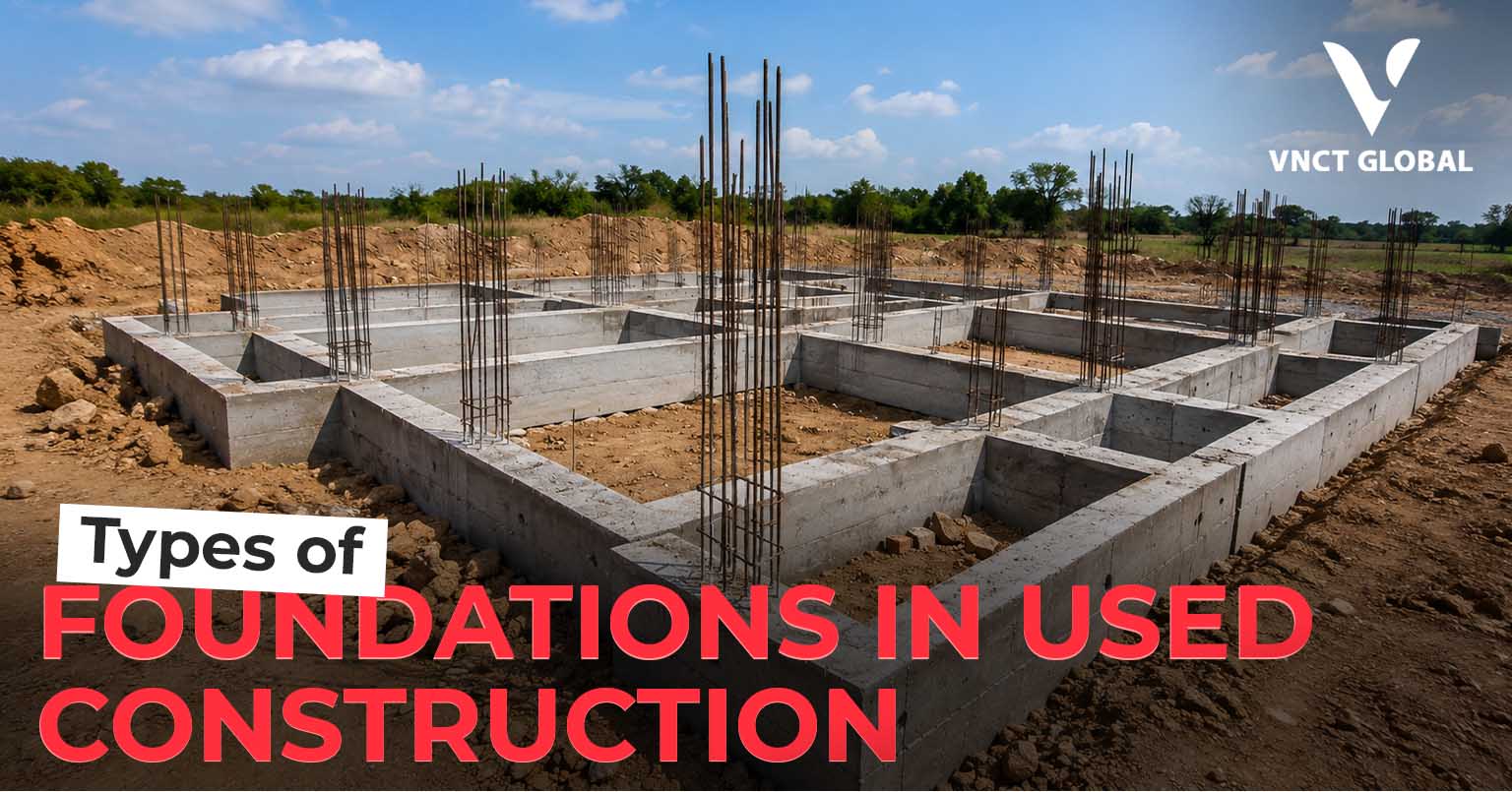
The Types of Foundations in Used Construction determine how a building transfers its load safely to the ground. Foundations are broadly classified into shallow foundations and deep foundations, with each type designed for different soil conditions, building loads, and project requirements. Choosing the right foundation improves structural stability, prevents settlement, and extends the lifespan of residential, commercial, and industrial buildings. Whether you’re constructing a home, villa, apartment, or commercial property, understanding foundation types helps ensure a safer investment and long-term durability.
Introduction
Every strong building begins below the ground. The Types of Foundations in Used Construction play a vital role in supporting the entire structure by safely transferring the building’s load to the soil. Without a properly designed foundation, even the most attractive building can experience settlement, cracks, uneven flooring, or severe structural damage over time.
Whether you’re planning to build your dream home, invest in premium villas in Chennai, explore modern villas in Madurai, or purchase elegant villas in Coimbatore, understanding the right foundation is just as important as choosing the architectural style. Reliable builders, including VNCT Global, carefully evaluate soil conditions before construction to ensure every project is built on a stable and durable foundation.
For homebuyers and investors searching for the best villa developers in india, the quality of the foundation is one of the most important indicators of long-term construction excellence. Similarly, the largest villa developers in india prioritize engineering standards and soil investigations to deliver safe and long-lasting communities.
What is a Foundation in Construction?
A foundation is the lowest structural element of a building that transfers the weight of the entire structure safely to the soil beneath it. It forms the base upon which columns, walls, beams, and floors are constructed.
The foundation acts as a bridge between the building and the earth. It distributes loads evenly while preventing excessive settlement and movement caused by varying soil conditions.
A well-designed foundation ensures that a building remains stable despite environmental factors such as heavy rainfall, groundwater fluctuations, earthquakes, and changing temperatures.
No matter how beautiful a building looks, its strength depends on the quality of its foundation.
Why are Foundations So Important?
Many homeowners focus on flooring, interiors, and exterior finishes but overlook what lies beneath the surface. The reality is that every component above ground depends entirely on the foundation below.
A properly constructed foundation helps:
- Transfer structural loads safely into the soil
- Prevent uneven settlement
- Protect walls from developing structural cracks
- Improve earthquake resistance
- Reduce moisture-related issues
- Increase the lifespan of the building
- Maintain structural alignment
- Enhance occupant safety
Without an adequate foundation, buildings may experience:
- Wall cracks
- Sloping floors
- Door and window misalignment
- Water seepage
- Structural instability
- Costly repairs
This is why experienced builders like VNCT Global conduct detailed site investigations before beginning construction. Their engineering-first approach helps create durable homes in projects such as Brookside Residences, Palm Shore, Palm Beach, Creek Residences, Park Villas, and Ocean Drive Villas, ensuring every home starts with a solid base.
Main Functions of a Foundation
The foundation performs several critical engineering functions beyond simply supporting a building.
1. Load Distribution
The primary role of a foundation is to distribute the weight of the building evenly across the soil, preventing localized pressure that could lead to settlement.
2. Structural Stability
Foundations anchor the building firmly, reducing movement caused by wind, earthquakes, or ground vibrations.
3. Settlement Control
Different soil layers compress differently. Proper foundation design minimizes differential settlement, keeping the structure level throughout its lifespan.
4. Moisture Protection
A well-designed foundation helps reduce moisture migration from the ground into the building, protecting walls and flooring.
5. Earthquake Resistance
Modern foundation systems are designed to improve a building’s ability to withstand seismic forces by evenly distributing dynamic loads.
6. Long-Term Durability
Strong foundations reduce maintenance costs by preventing structural damage that develops over decades.
Classification of Foundations
The Types of Foundations in Used Construction are generally classified into two major categories based on the depth at which they transfer loads.
| Foundation Type | Depth | Suitable For |
| Shallow Foundation | Up to approximately 3 meters | Residential buildings, villas, schools |
| Deep Foundation | More than 3 meters | High-rise buildings, bridges, heavy structures |
Each category contains several types designed for different soil conditions and structural loads.
Shallow Foundations
Shallow foundations are the most commonly used foundation systems for residential buildings because the load-bearing soil is available close to the ground surface.
These foundations are economical, easy to construct, and suitable for low- to medium-rise structures.
They are widely used in:
- Individual houses
- Duplex homes
- Villas
- Small commercial buildings
- Schools
- Hospitals
- Office buildings
Many of the best villa projects in Chennai, best villa projects in Coimbatore, and best villa projects in Madurai utilize well-engineered shallow foundations after thorough soil testing.
1. Isolated Footing (Pad Foundation)
What is an Isolated Footing?
An isolated footing is the simplest and most widely used shallow foundation. It supports a single column independently and transfers the column load directly to the soil.
It is generally square, rectangular, or circular in shape depending on the structural design.
Suitable For
- Independent houses
- Villas
- Small office buildings
- Low-rise apartments
Advantages
- Economical
- Easy to construct
- Requires less excavation
- Faster construction
- Lower reinforcement cost
Limitations
- Not suitable for weak soil
- Cannot support extremely heavy loads
- Differential settlement may occur in poor ground conditions
2. Combined Footing
Combined footing supports two or more columns using a single reinforced concrete footing.
This type is selected when:
- Columns are placed close together.
- Property boundaries restrict footing size.
- Soil bearing capacity is limited.
Advantages
- Better load distribution
- Efficient use of reinforcement
- Suitable for constrained sites
- Reduces differential settlement
Applications
- Residential complexes
- Commercial buildings
- Boundary-side constructions
3. Strip Footing (Continuous Footing)
Strip footing is a continuous strip of reinforced concrete placed beneath load-bearing walls or a row of closely spaced columns.
Unlike isolated footings, strip foundations support continuous structural elements.
Common Applications
- Compound walls
- Row houses
- Load-bearing wall structures
- Residential villas
Advantages
- Uniform load transfer
- Simple construction
- Cost-effective
- Suitable for moderate soil conditions
4. Raft Foundation (Mat Foundation)
A raft foundation consists of a large reinforced concrete slab supporting the entire building.
Instead of individual footings, one continuous slab distributes the building load across a much larger area.
Best Used When
- Soil has low bearing capacity
- Building loads are heavy
- Columns are closely spaced
- Settlement needs to be minimized
Advantages
- Excellent load distribution
- Reduces differential settlement
- Suitable for soft soil
- High structural stability
Common Applications
- Apartment buildings
- Commercial complexes
- Industrial buildings
- Large villas
5. Stepped Foundation
Stepped foundations are used on sloping land where the ground level changes gradually.
Instead of one continuous footing, the foundation is constructed in a series of steps that follow the natural slope.
Advantages
- Ideal for hilly terrain
- Reduces excavation
- Improves structural stability
- Minimizes soil disturbance
Common Uses
- Hill-side villas
- Sloped residential plots
- Mountain homes
- Retaining wall systems
Introduction to Deep Foundations
While shallow foundations are sufficient for many residential buildings, they may not be suitable when the surface soil lacks the strength to support structural loads. In such cases, engineers turn to deep foundations, which transfer the load to stronger soil or rock layers located much deeper below the ground.
Deep foundations are commonly used for high-rise buildings, bridges, towers, waterfront structures, and projects built on weak or waterlogged soil. They require specialized equipment and engineering expertise but provide exceptional stability for heavy structures.
In the next section, we’ll explore the different types of deep foundations, including pile foundations, drilled shafts, caissons, and other advanced systems, along with their applications, advantages, and selection criteria.
Types of Deep Foundations
When the upper layers of soil cannot safely support a building, engineers use deep foundations to transfer structural loads to stronger soil or rock located at greater depths. Unlike shallow foundations, deep foundations are designed to provide stability for heavy structures and sites with poor soil conditions.
These foundation systems are widely used in:
- High-rise buildings
- Commercial complexes
- Industrial plants
- Bridges and flyovers
- Coastal constructions
- Water tanks
- Multi-storey apartments
- Infrastructure projects
The selection of a deep foundation depends on several factors, including soil type, groundwater level, structural load, budget, and construction timeline.
1. Pile Foundation
A pile foundation is one of the most commonly used deep foundation systems. It consists of long, slender columns made of reinforced concrete, steel, timber, or composite materials that are driven or bored deep into the ground until they reach a stable soil layer.
Pile foundations are ideal when the surface soil is soft, loose, or unable to carry heavy structural loads.
When is a Pile Foundation Used?
Engineers typically recommend pile foundations when:
- The topsoil has low bearing capacity.
- The structure is very heavy.
- Construction is near rivers, lakes, or coastal regions.
- Groundwater levels are high.
- The site contains expansive clay or loose sandy soil.
Advantages
- Suitable for weak soils
- Excellent load-bearing capacity
- Reduces settlement
- Performs well in seismic zones
- Ideal for waterlogged areas
- Long service life
Limitations
- Higher construction cost
- Requires specialized machinery
- Longer installation time
- Professional supervision is essential
Types of Pile Foundations
End Bearing Piles
These piles transfer the building load directly to a strong rock or dense soil layer located deep underground.
They act like columns supporting the structure from below.
Best For
- High-rise buildings
- Bridges
- Heavy industrial structures
Friction Piles
When no hard layer is available nearby, friction piles transfer the load through friction between the pile surface and surrounding soil.
These piles are commonly used in clayey or loose soils.
Best For
- Soft clay
- Loose sand
- Coastal construction
Sheet Piles
Sheet piles are mainly used for retaining soil and preventing water ingress rather than supporting vertical building loads.
Applications include:
- Basement construction
- Retaining walls
- River embankments
- Coastal protection
2. Drilled Shaft Foundation (Bored Piles)
A drilled shaft foundation, also known as a bored pile foundation, is created by drilling a deep hole into the ground and filling it with reinforced concrete.
Unlike driven piles, bored piles produce less vibration and are suitable for urban environments where nearby structures must not be disturbed.
Advantages
- Minimal vibration
- Reduced construction noise
- Suitable for restricted urban sites
- Can support extremely heavy loads
- Excellent durability
Common Applications
- Commercial buildings
- Hospitals
- Metro stations
- Residential towers
- Office complexes
3. Caisson Foundation
A caisson foundation is a watertight structure that is sunk into the ground or underwater before being filled with concrete.
This type of foundation is mainly used for projects built in or near water bodies.
Applications
- Bridges
- Dams
- Ports
- Marine structures
- Offshore construction
Advantages
- Excellent underwater stability
- High load-bearing capacity
- Long lifespan
- Resistant to water pressure
4. Pier Foundation
Pier foundations consist of large cylindrical columns that transfer loads to stable soil or rock beneath weak surface layers.
These foundations are generally constructed by excavating cylindrical holes and filling them with reinforced concrete.
Suitable For
- Medium-rise buildings
- Elevated homes
- Bridges
- Buildings on sloping terrain
Shallow Foundation vs Deep Foundation
| Feature | Shallow Foundation | Deep Foundation |
| Depth | Usually less than 3 m | More than 3 m |
| Cost | Lower | Higher |
| Construction Time | Faster | Longer |
| Suitable Soil | Strong surface soil | Weak surface soil |
| Load Capacity | Moderate | Very High |
| Equipment | Standard | Specialized |
| Residential Villas | Yes | Sometimes |
| High-rise Buildings | Limited | Highly Suitable |
Factors Affecting Foundation Selection
Selecting the right foundation is not simply about cost. Engineers carefully evaluate multiple site conditions before deciding on the most suitable foundation system.
1. Soil Bearing Capacity
The strength of the soil is one of the most important factors.
Dense gravel and hard rock can support heavier loads, while clay and loose sand often require deeper foundations.
2. Type of Structure
Different buildings impose different loads.
For example:
- Individual house
- Duplex villa
- Luxury villa
- Apartment
- Shopping mall
- Hospital
- Warehouse
Each requires a different foundation design.
3. Groundwater Level
High groundwater can weaken excavation and increase construction complexity.
Special waterproofing and drainage systems may also be required.
4. Building Load
Heavier structures need larger or deeper foundations.
The total structural load includes:
- Dead load
- Live load
- Wind load
- Earthquake load
5. Soil Settlement
Engineers calculate expected settlement before construction begins.
Excessive settlement may cause:
- Wall cracks
- Uneven floors
- Structural damage
- Plumbing failures
6. Site Conditions
The following conditions also influence foundation selection:
- Slope
- Nearby buildings
- Trees
- Underground utilities
- Flood-prone areas
- Coastal regions
Importance of Soil Testing Before Foundation Construction
A foundation should never be designed based on assumptions. Soil testing provides engineers with valuable information about the ground conditions before construction begins.
A geotechnical investigation helps determine:
- Soil type
- Bearing capacity
- Moisture content
- Density
- Groundwater level
- Rock depth
These findings allow structural engineers to recommend the safest and most cost-effective foundation system.
Professional developers such as VNCT Global prioritize soil investigations before starting construction, helping ensure that every home is built on a stable base. This attention to engineering detail contributes to the quality of projects like Brookside Residences, Palm Shore, Palm Beach, Creek Residences, Park Villas, and Ocean Drive Villas.
Foundation Construction Process
Although the exact process varies depending on the project, the following steps are commonly followed.
Step 1 – Site Survey
Engineers inspect the site to understand topography, accessibility, drainage, and surrounding structures.
Step 2 – Soil Investigation
A detailed soil test is conducted to evaluate bearing capacity and recommend the appropriate foundation type.
Step 3 – Structural Design
Structural engineers design the footing dimensions, reinforcement, and concrete specifications based on the building load.
Step 4 – Excavation
The required depth is excavated using manual or mechanical methods while maintaining safety and stability.
Step 5 – PCC (Plain Cement Concrete)
A PCC layer is placed to create a clean, level base before reinforcement is installed.
Step 6 – Reinforcement Placement
Steel reinforcement bars are arranged according to structural drawings to provide tensile strength.
Step 7 – Formwork Installation
Shuttering is installed to retain the concrete in the desired shape during casting.
Step 8 – Concrete Pouring
Concrete is poured continuously and compacted using vibrators to eliminate air pockets.
Step 9 – Curing
Proper curing is carried out for the recommended duration to achieve the required strength and durability.
Step 10 – Backfilling
After the concrete gains sufficient strength, the excavated area is backfilled and compacted.
Common Mistakes to Avoid During Foundation Construction
Avoiding these mistakes can significantly improve the lifespan of a building:
- Skipping soil testing
- Using low-quality construction materials
- Inadequate reinforcement
- Poor concrete compaction
- Insufficient curing
- Incorrect foundation depth
- Ignoring drainage requirements
- Building without structural engineering approval
NRI Guide: Why Understanding Foundations Matters Before Buying a Villa
For Non-Resident Indians (NRIs), purchasing property in India is a major investment, and many buyers focus on location, design, and amenities. However, one of the most critical aspects to evaluate is the quality of the foundation.
A strong foundation ensures that the property remains safe, durable, and structurally sound for decades. Before investing in villas in Chennai, villas in Madurai, or villas in Coimbatore, NRIs should ask developers about soil testing reports, foundation design, construction standards, and quality control processes.
Choosing projects from the best villa developers in india can provide greater confidence, as reputed builders follow established engineering practices and comply with regulatory standards. Likewise, the largest villa developers in india often invest in advanced geotechnical investigations and quality assurance to deliver reliable homes.
At VNCT Global, every project is planned with a focus on long-term structural performance. From soil evaluation to foundation execution, the team emphasizes quality construction to create homes that are built to last. Whether you’re exploring best villa projects in Chennai, best villa projects in Coimbatore, or best villa projects in Madurai, understanding the foundation is an essential step toward making an informed investment.
If you’re an NRI visiting India or planning your property search around events in Dubai and overseas property exhibitions, it’s worth discussing construction practices directly with the developer. For project details or assistance, you can also reach out through contact us VNCT Global to learn more about available communities and support services.
How VNCT Global Delivers Strong and Reliable Villa Communities
At VNCT Global, every project begins with careful planning rather than simply starting construction. Before laying the first foundation, the engineering team evaluates the site’s soil conditions, drainage, topography, and structural requirements to determine the most suitable foundation system.
This engineering-first approach helps ensure that each home is designed for long-term durability, safety, and performance.
Some of the key construction practices followed include:
- Comprehensive site evaluation before construction
- Soil testing and engineering recommendations
- High-quality concrete and reinforcement materials
- Structural designs that comply with engineering standards
- Strict quality checks during every stage of construction
- Professional supervision throughout the project lifecycle
- Focus on long-term durability instead of short-term cost savings
These practices help create villa communities that offer peace of mind for homeowners and investors alike.
Premium Villa Communities by VNCT Global
Homebuyers looking for thoughtfully planned residential developments can explore several projects by VNCT Global, each designed with quality construction and modern living in mind.
Brookside Residences
A well-planned residential community offering comfortable living spaces with attention to construction quality and infrastructure.
Palm Shore
Designed for modern families seeking a balance of comfort, connectivity, and contemporary architecture.
Palm Beach
A premium villa development that combines elegant design with quality engineering practices.
Creek Residences
Built for homeowners who value peaceful surroundings, functional layouts, and long-term structural reliability.
Park Villas
A community that emphasizes open spaces, thoughtful planning, and durable construction techniques.
Ocean Drive Villas
An ideal option for buyers looking for premium villas with modern amenities and carefully executed construction standards.
Whether you’re searching for the best villa projects in Chennai, the best villa projects in Coimbatore, or the best villa projects in Madurai, choosing a project backed by sound engineering and quality construction can make a significant difference over the years.
How VNCT Global Supports NRI Buyers
Buying property while living abroad can sometimes feel overwhelming. At VNCT Global, the goal is to make the process straightforward and transparent for NRI customers.
Support services include:
- Personalized property consultations
- Virtual project presentations and walkthroughs
- Assistance with documentation
- Regular construction updates
- Dedicated customer support
- Guidance throughout the booking process
- Help with property selection based on your requirements
Whether you’re living in the UAE, Singapore, the United States, the United Kingdom, Australia, or another country, the team works to simplify every stage of your home-buying journey.
Many overseas buyers also connect with the team during events in Dubai, where they can explore investment opportunities, understand project details, and receive expert guidance before making a decision. For additional information or personalized assistance, you can always contact us VNCT Global.
Conclusion
The Types of Foundations in Used Construction directly influence the strength, safety, and lifespan of any building. From simple isolated footings used in residential homes to advanced pile and caisson foundations supporting large infrastructure projects, every foundation has a specific purpose based on soil conditions and structural requirements.
Understanding these foundation systems helps homeowners, builders, and investors make informed construction decisions while reducing the risk of future structural issues.
If you’re planning to invest in villas in Chennai, villas in Madurai, or villas in Coimbatore, don’t overlook what lies beneath the surface. A well-designed foundation, supported by proper soil testing and quality engineering, provides confidence that your investment will remain safe and durable for years to come.
Choosing a trusted developer that values engineering excellence and construction quality is just as important as selecting the right location. That’s why many homebuyers consider projects from the best villa developers in india, while others explore communities built by the largest villa developers in india for their commitment to quality and long-term value.
At VNCT Global, every project is developed with a focus on structural integrity, customer satisfaction, and sustainable construction practices. Whether you’re looking for your first home or making an investment from overseas, understanding the foundation is the first step toward building a secure future.
FAQs for Types of Foundations
What are the main Types of Foundations in Used Construction?
The two main categories are shallow foundations and deep foundations. The choice depends on soil conditions, building load, and project requirements.
Which foundation is best for a residential house?
For most residential homes with good soil conditions, isolated footing or strip footing is commonly used. However, the final decision should always be based on a soil investigation.
What is the difference between shallow and deep foundations?
Shallow foundations transfer loads near the ground surface, while deep foundations carry loads to stronger soil or rock layers located much deeper.
Why is soil testing important before construction?
Soil testing determines the soil’s bearing capacity, moisture content, and other properties, helping engineers design the safest and most suitable foundation.
Which foundation is suitable for weak soil?
Pile foundations and raft foundations are often recommended for sites with weak or low-bearing-capacity soil.
What is an isolated footing?
An isolated footing is a shallow foundation that supports a single column and is commonly used in individual homes and villas.