Introduction
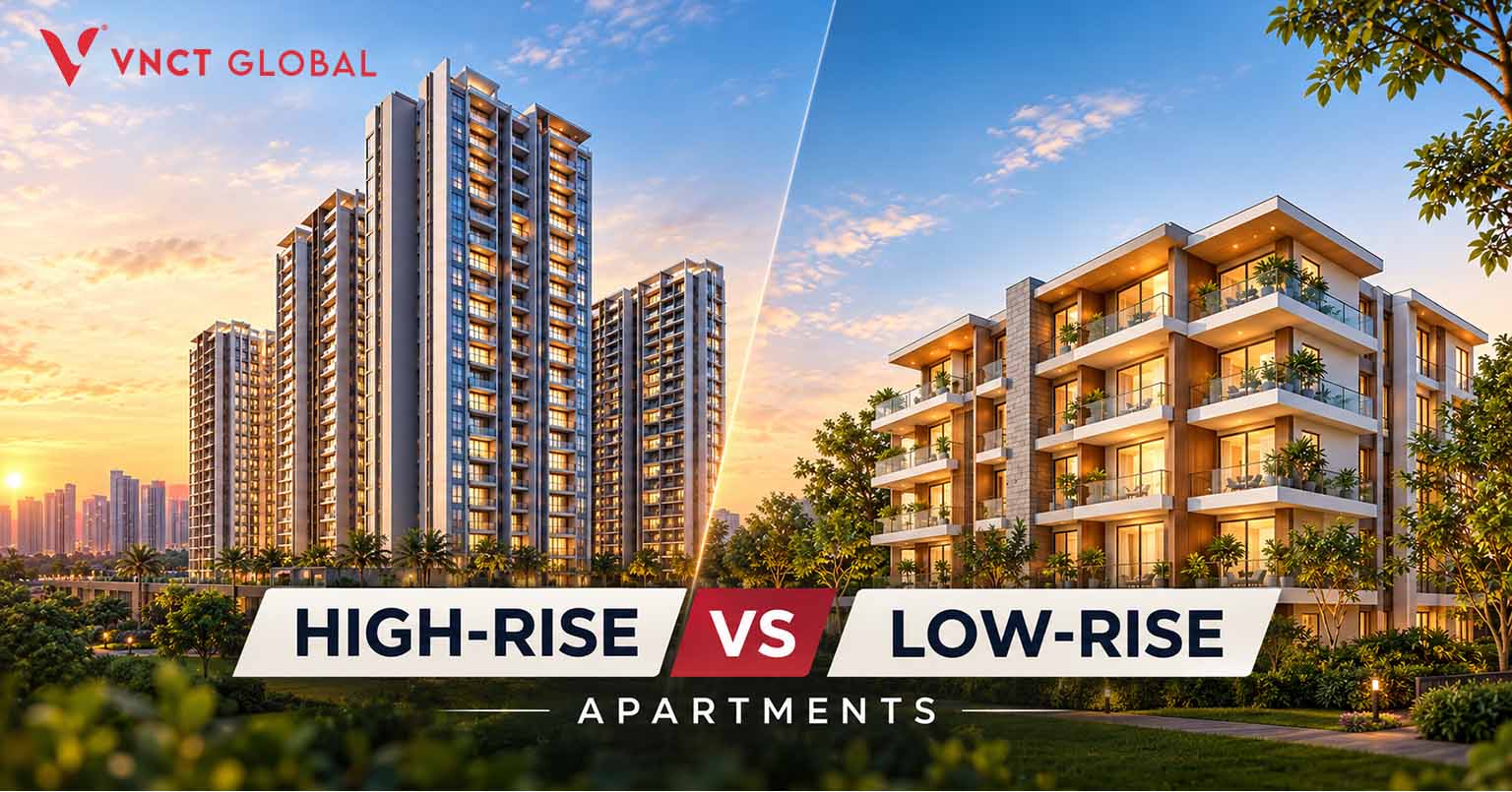
High-Rise vs Low-Rise Apartments is a decision that looks simple on paper, but the difference becomes much more noticeable once you actually live in the property. A high-rise may give you better views, more amenities and a modern city lifestyle, while a low-rise apartment can offer easier access, fewer neighbours and a quieter residential environment.
For families, working professionals and NRI buyers, the right choice depends less on the number of floors and more on how you expect to use your home every day.
AI Overview
High-rise apartments are generally better suited to buyers who value amenities, city views, security, modern facilities and urban convenience.
Low-rise apartments can be a better fit for families who prefer lower-density living, easier accessibility, fewer residents and a more residential atmosphere.
Neither option is automatically better.
If you are buying a home for your family, consider your age, lifestyle, maintenance budget, daily travel, children, elderly parents and long-term plans before choosing.
What Is a High-Rise Apartment?
A high-rise apartment is a multi-storey residential building with a large number of floors and housing units. The exact definition can vary depending on local building regulations, but property guides commonly distinguish high-rise buildings from low-rise developments based on their height and number of storeys.
High-rise developments are common in major urban areas because vertical construction allows developers to accommodate more homes on a limited parcel of land.
They often come with facilities such as:
- Swimming pools
- Gyms
- Clubhouses
- Children’s play areas
- Security systems
- Covered parking
- Lifts
- Landscaped areas
- Community spaces
For someone who enjoys having several facilities within the same residential community, a high-rise can be attractive.
What Is a Low-Rise Apartment?
Low-rise apartments generally have fewer floors and a smaller number of homes compared with large high-rise towers.
The biggest difference is not simply building height. It is the density and experience of living in the community.
With fewer floors and residents, low-rise developments can feel more like a neighbourhood than a large residential tower.
This can appeal to:
- Families with children
- Senior citizens
- Buyers who prefer quieter surroundings
- People who don’t want heavy dependence on lifts
- Buyers who value lower-density communities
Low-rise apartments are also sometimes positioned between traditional apartments and independent homes, offering some of the convenience of apartment living without the scale of a large tower.
High-Rise vs Low-Rise Apartments: Key Differences
| Factor | High-Rise Apartment | Low-Rise Apartment |
| Building height | Higher | Lower |
| Number of residents | Usually higher | Usually lower |
| Views | Often better from upper floors | More limited |
| Amenities | Usually extensive | Depends on project |
| Lift dependency | High | Lower |
| Privacy | Can be good on upper floors | Often more intimate |
| Community size | Larger | Smaller |
| Accessibility | More dependent on lifts | Easier |
| Maintenance | Can be higher | May be lower |
| Lifestyle | Urban and amenity-focused | Quieter and more residential |
The important point is that these are general tendencies, not rules. A well-designed low-rise development can have excellent amenities, while a poorly managed high-rise can have significant maintenance problems.
Privacy and Community Living
Privacy means different things to different people.
A high-rise apartment can provide privacy because your home is physically separated from street-level activity. Upper-floor apartments can also have fewer direct views into the home from surrounding properties.
However, large high-rise developments may have hundreds or even thousands of residents sharing lifts, parking areas, clubhouses and common spaces.
Low-rise developments usually have fewer homes within each block. That can create a more familiar community environment.
For a family that prefers a quieter atmosphere and fewer people around common areas, low-rise living may feel more comfortable.
If you enjoy larger communities and don’t mind shared facilities, high-rise living may suit you better.
Amenities and Convenience
This is one area where high-rise developments often have an advantage.
Large projects can justify investing in facilities such as gyms, swimming pools, indoor sports areas, clubhouses and landscaped recreational spaces. Housing.com also highlights amenities and urban convenience as significant advantages associated with high-rise developments.
But amenities come with a question that buyers sometimes overlook:
How much will you actually use them?
If you rarely use the swimming pool or clubhouse, paying higher maintenance charges for extensive facilities may not provide much value.
A smaller community with fewer amenities may be more suitable for a buyer who prefers simplicity.
Maintenance and Monthly Costs
Maintenance should be considered before buying, not after possession.
High-rise buildings typically have more shared infrastructure:
- Multiple lifts
- Larger electrical systems
- Security infrastructure
- Common-area lighting
- Swimming pools
- Clubhouses
- Larger landscaped areas
- Mechanical and fire-safety systems
That infrastructure requires regular maintenance.
Low-rise developments may have fewer shared systems, although the actual maintenance cost depends entirely on the project.
Don’t assume that a low-rise apartment will always be cheaper to maintain or that every high-rise will be expensive.
Ask the developer or association for the expected maintenance structure and understand exactly what your monthly charges cover.
Accessibility – An Important Factor for Families
For a young professional, climbing a few stairs may not be a concern.
For an elderly parent, someone with mobility difficulties or a family carrying groceries and managing young children, accessibility can become much more important.
High-rise living means greater dependence on lifts.
During normal days, this may not matter. But lift maintenance, power interruptions or periods of heavy usage can make the difference noticeable.
Low-rise apartments can provide easier access between the home and ground level.
This is one reason recent Chennai apartment guidance recommends considering family composition and accessibility rather than automatically assuming that a higher floor is better.
Views, Ventilation and Natural Light
This is probably the most obvious advantage of a high-rise.
Upper-floor homes can provide:
- Wider views
- More open surroundings
- Better exposure to daylight
- Greater separation from street-level activity
But don’t buy a high-rise purely for the view.
The surrounding development can change.
A vacant plot next to your property today may become another building tomorrow.
For any apartment, check the actual orientation, window placement, ventilation and surrounding development rather than relying only on the sample flat.
Safety and Emergency Access
Safety is another factor where buyers need to look beyond marketing.
High-rise developments require more sophisticated systems because residents live at greater heights and evacuation is more complex.
When comparing projects, ask about:
- Fire detection systems
- Fire-fighting equipment
- Emergency exits
- Staircase access
- Backup power
- Security systems
- Regular safety inspections
- Emergency vehicle access
Do not judge safety simply by whether a project has a security guard at the entrance.
For low-rise properties, emergency access may be simpler because residents are closer to ground level, but the project’s fire and safety arrangements still need to be checked.
Check Here: Invest ₹2 Crore in Chennai in 2026
Which Is Better for NRI Buyers?
For an NRI, the decision becomes slightly different.
You may spend most of the year outside India, which means you need a property that is easy for your family to use and easy to manage when you are away.
A high-rise apartment can be attractive because security, common-area maintenance and building management are usually handled through the residential association or facility-management system.
At the same time, an NRI who wants a long-term family home may prefer a lower-density property with more privacy and personal space.
Before buying, ask:
Will this be my investment, my family’s home, my holiday property or my future retirement home?
That answer can change the right choice completely.
NRIs and OCIs are permitted to acquire residential and commercial immovable property in India subject to applicable FEMA/RBI rules. Payments must also follow permitted channels, including banking channels and eligible NRE/FCNR(B)/NRO account routes.
Why Some NRIs Consider Villas Instead
For some NRI families, the real comparison isn’t high-rise versus low-rise.
It is:
Apartment living vs. owning a villa.
An apartment can provide convenience, security and shared amenities.
A villa can provide something different:
- Private outdoor space
- More privacy
- Larger living areas
- Independent access
- Greater control over the property
- A stronger sense of ownership
- Space for family gatherings
This is one reason some buyers researching villas in chennai also compare them against premium apartments before making a final decision.
The choice depends on what you value.
If convenience is your priority, an apartment may win.
If space and privacy matter more, a villa may be worth considering.
How VNCT Global Supports NRI Buyers
For an NRI, purchasing property from another country can be complicated. Flying to Chennai for every discussion, document review or site visit isn’t always practical.
This is where a developer’s NRI support process becomes important.
VNCT Global focuses on villa and bungalow developments rather than positioning its portfolio around high-rise apartment living.
For NRI buyers, the process can include:
- Digital project presentations
- Virtual property discussions
- Video walkthroughs
- Assistance in arranging site visits
- Project and construction updates
- Guidance through the purchase process
- Coordination with family members in India
- Handover support
- Post-purchase assistance
This allows an NRI to shortlist properties remotely and plan an in-person visit when necessary.
For buyers who meet property developers during events in Dubai or other international NRI events, an initial consultation can also help identify suitable projects before travelling to Chennai.
If you want to compare villa options based on your budget, location and family requirements, contact us VNCT Global to discuss your requirements.
VNCT Global Villa Options
If you decide that a villa provides a better fit than apartment living, the next step is to compare individual projects rather than simply choosing a developer based on online rankings.
VNCT Global’s Chennai portfolio includes projects such as Palm Shore, Palm Beach, Brookside Residences, Creek Residences, Park Villas and Ocean Drive Villas, among other developments.
Different projects suit different requirements.
For example, an NRI looking for a coastal lifestyle may have different priorities from a family looking for convenient access to the city.
So, instead of asking which project is the best villa projects in Chennai, compare:
- Location
- Plot size
- Built-up area
- Road connectivity
- Construction quality
- Documentation
- Community facilities
- Maintenance
- Future usability
That gives you a much more realistic picture.
What About Villas in Madurai and Coimbatore?
Not every NRI family needs a Chennai property.
If your parents live in Madurai or Coimbatore, or if you expect to return to one of these cities, buying closer to your family may make more sense.
You may therefore come across searches for villas in madurai and villas in coimbatore while comparing Tamil Nadu property options.
The same rule applies everywhere.
Don’t choose a property simply because it is promoted as one of the best villa projects in Madurai or best villa projects in Coimbatore.
Look at the location, developer record, documentation, construction quality and how the property fits your family’s actual plans.
How to Choose the Right Villa or Apartment Developer
Online searches for best villa developers in india can be useful when you are starting your research, but rankings alone should never determine a property purchase.
Likewise, searches for best villa devlopers in india or largest villa devlopers in india may give you a shortlist, but the final decision should be based on the individual project.
Check:
- Completed projects
- Construction quality
- Delivery record
- Legal documentation
- Approvals
- Customer feedback
- Location
- After-sales support
- Maintenance arrangements
The same approach applies if you are comparing a House construction company in chennai.
A recognised name can be a starting point, but the actual property, agreement and construction standards matter more.
Check Here: Lintel in Construction – Types and Key Functions
Common Mistakes Buyers Should Avoid
Choosing the highest floor automatically
A higher floor may provide better views, but it also increases dependence on lifts. Choose based on your lifestyle.
Paying for amenities you won’t use
A large clubhouse looks impressive, but consider whether you will actually use it.
Ignoring maintenance costs
Calculate the expected monthly and annual costs before purchasing.
Forgetting about elderly family members
If parents will live in the property, accessibility should be part of the decision from the beginning.
Comparing only the apartment price
Look at the total cost, including parking, registration, maintenance deposits, interiors and other charges.
Making a decision from a brochure
Visit the property where possible. Speak to residents if the project is occupied. Check the documents independently.
High-Rise or Low-Rise: Which One Should You Choose?
There is no universal winner.
Choose a high-rise apartment if you value:
- Modern amenities
- City views
- Security systems
- Large residential communities
- Urban convenience
- Facilities within the development
Choose a low-rise apartment if you value:
- Lower-density living
- Easier accessibility
- Smaller communities
- A quieter environment
- Less dependence on lifts
- A more residential feel
And if neither option gives you the privacy and space your family wants, a villa may deserve a place on your shortlist.
The best home isn’t necessarily the tallest building or the smallest community.
It is the property that fits how you actually live.
Conclusion
Choosing between a high-rise and a low-rise apartment ultimately comes down to how you want to live, not simply how many floors the building has.
A high-rise apartment can be the right choice if you value modern amenities, city views, security, convenience and access to a larger residential community. A low-rise apartment may suit you better if you prefer easier accessibility, fewer neighbours, lower-density living and a quieter residential environment.
For NRI buyers, the decision deserves a little more thought. Consider how often you will use the property, who will live there, how it will be maintained while you are abroad and whether the property fits your long-term plans in India.
And if you find that neither apartment format provides the privacy, outdoor space and independence your family wants, a villa could be worth considering.
Before making the final decision, compare the location, construction quality, approvals, maintenance costs, developer track record and long-term value rather than choosing a property based only on its floor count or amenities.
The best home is ultimately the one that fits your family’s lifestyle today and continues to work for you in the years ahead.
FAQ’s For High-Rise vs Low-Rise Apartments
Is a high-rise apartment better than a low-rise apartment?
Not necessarily. High-rises can offer more amenities, views and urban convenience, while low-rise apartments can provide easier access, lower density and a quieter environment.
Are high-rise apartments more expensive to maintain?
They can have higher maintenance requirements because of lifts, security systems, common facilities and larger shared infrastructure. However, actual charges vary by project.
Are low-rise apartments better for families?
They can be a good choice for families who prefer fewer residents, easier access and a quieter environment. The project design and location still matter.
Which is better for elderly parents?
Low-rise living can be more convenient because there is less dependence on lifts. In a high-rise, check lift availability, backup power and emergency access carefully.
Do high-rise apartments have better resale value?
Not automatically. Resale depends on location, project quality, apartment layout, maintenance, demand, age of the building and surrounding development.
Are high-rise apartments suitable for NRIs?
Yes. They can be suitable for NRIs who value security, managed common areas and amenities. The quality of property management is particularly important when the owner lives abroad.
Can NRIs buy apartments or villas in India?
NRIs and OCIs can generally purchase residential and commercial immovable property in India, subject to applicable FEMA/RBI rules. Certain categories such as agricultural land, plantation property and farmhouses are subject to different restrictions.
Should NRIs consider villas instead of apartments?
If privacy, outdoor space and larger living areas are priorities, a villa may be worth considering. If convenience, security and shared amenities are more important, an apartment may be a better fit.
What should I check before buying a high-rise apartment?
Check approvals, title, RERA registration where applicable, fire-safety systems, lift maintenance, association charges, water supply, parking and the project’s overall maintenance record.
How can VNCT Global help NRI buyers?
VNCT Global can help NRI buyers understand its villa projects, compare locations, arrange virtual discussions and coordinate the property-buying process with buyers and their families in India.