AI Overview
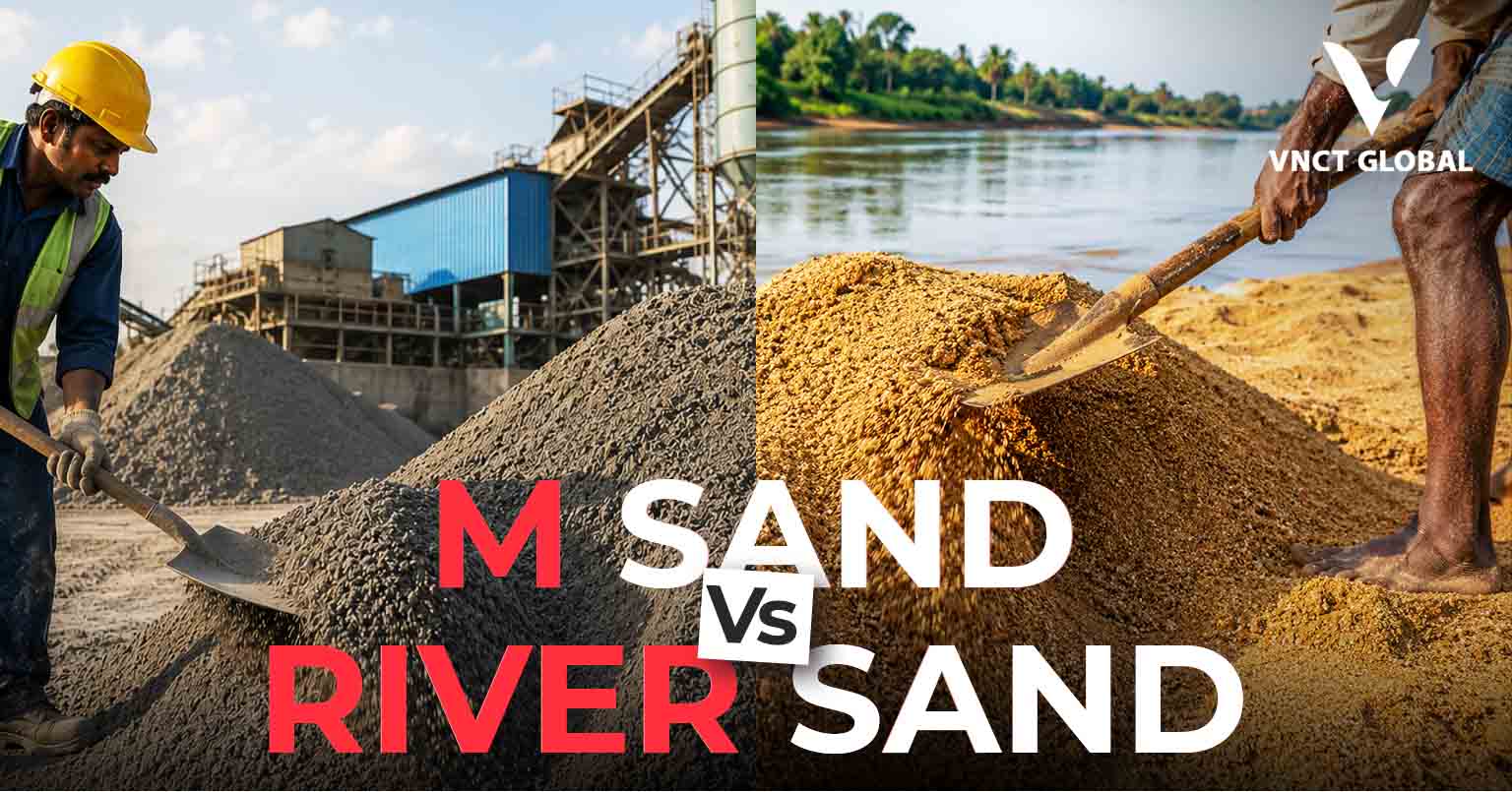
M Sand Vs River Sand is one of the most common comparisons in the construction industry. M Sand (Manufactured Sand) is produced by crushing hard granite rocks under controlled conditions, resulting in consistent quality, better strength, and reduced impurities. River Sand is naturally formed through weathering and transported by rivers over thousands of years. While River Sand has traditionally been used in construction, M Sand has become the preferred choice for modern residential and commercial projects due to its availability, quality control, environmental benefits, and cost-effectiveness.
For homeowners, builders, and investors, especially those planning premium villas, understanding the differences between these two materials is essential. The right choice directly affects the durability, finish, and long-term performance of the structure.
Introduction
When planning a home or villa construction project, every building material plays an important role in determining the quality and lifespan of the structure. Among these materials, sand is one of the most essential components because it influences the strength of concrete, mortar, plastering, and masonry work. M Sand Vs River Sand is a topic that every homeowner, builder, architect, and property investor should understand before beginning construction.
For decades, River Sand was the preferred option across India. However, increasing environmental regulations, rising prices, and limited availability have encouraged the construction industry to shift towards Manufactured Sand (M Sand). Today, engineers and leading construction companies recommend M Sand for most structural applications due to its consistent quality and controlled production process.
If you are planning to build your dream home or invest in premium villas in Chennai, villas in Madurai, or villas in Coimbatore, choosing the right construction materials becomes even more important. Reputed companies like VNCT GLOBAL, recognized among the best villa developers in India, carefully select high-quality materials to ensure every villa meets modern engineering standards while delivering long-lasting value to homeowners.
In this comprehensive guide, we’ll explore everything you need to know about M Sand Vs River Sand, including their properties, advantages, disadvantages, cost differences, environmental impact, applications, and expert recommendations for residential and villa construction.
Why is Sand Important in Construction?
Sand may appear to be a simple material, but it performs several important functions within a building.
It helps bind cement with aggregates to produce strong concrete, improves workability during construction, reduces shrinkage cracks, enhances durability, and contributes to the overall structural integrity of a building.
Whether you’re constructing a small independent home or investing in luxury villas, selecting the right sand affects:
- Foundation strength
- Concrete durability
- Wall plaster quality
- Masonry performance
- Waterproofing efficiency
- Overall lifespan of the building
Poor-quality sand can introduce clay, silt, salts, and organic impurities into concrete, reducing its strength and increasing maintenance costs over time.
What is M Sand?
Manufactured Sand, commonly known as M Sand, is an artificial sand produced by crushing hard granite stones into fine particles. Unlike natural sand, M Sand is manufactured in advanced crushing plants under controlled conditions, ensuring uniform size, shape, and quality.
The production process involves multiple stages, including primary crushing, secondary crushing, screening, washing, and grading. Each batch undergoes quality checks to meet construction standards.
Because of this controlled manufacturing process, M Sand offers better consistency than naturally available sand.
Key Characteristics of M Sand
- Manufactured using hard granite rocks
- Uniform particle size
- Low silt content
- Free from organic impurities
- Better bonding with cement
- High compressive strength
- Available throughout the year
Modern infrastructure projects, residential townships, commercial buildings, and premium villa developments increasingly rely on M Sand because of its reliable quality.
What is River Sand?
River Sand is naturally formed over thousands of years through the erosion and weathering of rocks. Flowing rivers carry rock particles downstream, where continuous friction gradually transforms them into smooth, rounded sand grains.
For many decades, River Sand was the preferred construction material because of its natural texture and ease of use.
However, excessive river sand mining has created serious environmental concerns, leading many state governments to regulate extraction.
Characteristics of River Sand
- Naturally occurring
- Rounded particles
- Smooth texture
- Limited availability
- Variable quality
- May contain impurities
- Higher transportation costs
Since River Sand is collected from different riverbeds, its quality often varies depending on the source and extraction process.
Why Has M Sand Become Popular?
Over the last decade, India’s construction industry has undergone significant changes.
Several factors have contributed to the growing popularity of M Sand:
Environmental Regulations
Governments have imposed strict restrictions on illegal river sand mining to protect ecosystems, groundwater, and riverbeds.
Increasing Construction Demand
India’s rapidly growing urban population has significantly increased the demand for construction materials. Natural River Sand alone cannot meet this demand.
Consistent Quality
Unlike River Sand, M Sand is manufactured under controlled conditions, providing uniform grading and consistent performance.
Cost Stability
Since M Sand is locally manufactured, transportation costs are generally lower, making it more economical in many regions.
Better Strength
Angular particles improve the bond between cement paste and aggregates, resulting in stronger concrete.
Manufacturing Process of M Sand
One of the biggest advantages of M Sand lies in its manufacturing process.
The process includes several carefully monitored stages:
1. Selection of Rocks
High-quality granite rocks are selected for crushing.
2. Primary Crushing
Large stones are broken into smaller pieces using jaw crushers.
3. Secondary Crushing
Cone crushers further reduce the stone size.
4. Vertical Shaft Impact Crusher
The particles are shaped to resemble natural sand.
5. Screening
Particles are screened according to IS standards.
6. Washing
Dust, micro-fines, and impurities are removed.
7. Quality Testing
Every batch undergoes testing for:
- Particle size distribution
- Specific gravity
- Moisture content
- Fineness modulus
- Silt percentage
- Compressive strength compatibility
This systematic production ensures high-quality sand suitable for structural concrete.
How River Sand is Formed
River Sand is created naturally through geological processes spanning thousands of years.
Rain, wind, temperature changes, and flowing water gradually erode rocks. These rock fragments travel downstream, continuously rubbing against each other until they become fine sand particles.
Eventually, the sand settles along riverbeds and banks, where it is extracted for construction purposes.
Although this natural process creates smooth particles, the quality cannot be controlled, making each batch different from another.
Types of M Sand
Different construction activities require different grades of sand. M Sand is manufactured accordingly.
1. Concrete M Sand
Used for:
- RCC structures
- Foundations
- Beams
- Columns
- Slabs
This type offers high compressive strength and excellent bonding.
2. Plastering M Sand
Specifically designed for wall plastering.
Benefits include:
- Smooth finish
- Better adhesion
- Reduced cracks
- Uniform texture
3. Brick Masonry M Sand
Suitable for:
- Brickwork
- Block masonry
- Compound walls
- Partition walls
Its particle size ensures better mortar consistency.
4. P-Sand
P Sand refers to premium plastering sand manufactured with finer grading.
Applications include:
- Decorative finishes
- Interior plaster
- Ceiling work
- Architectural detailing
Physical Properties of M Sand
| Property | M Sand |
| Shape | Angular |
| Texture | Rough |
| Silt Content | Very Low |
| Organic Matter | Negligible |
| Particle Size | Uniform |
| Water Absorption | Moderate |
| Bond Strength | Excellent |
| Availability | High |
The angular nature of M Sand increases the interlocking effect between cement paste and aggregates, leading to stronger concrete.
Physical Properties of River Sand
| Property | River Sand |
| Shape | Rounded |
| Texture | Smooth |
| Silt Content | Can vary |
| Organic Matter | Possible |
| Particle Size | Variable |
| Water Absorption | Low |
| Bond Strength | Moderate |
| Availability | Limited |
Because River Sand particles are rounded, they require comparatively less water but may provide slightly lower bonding strength than angular M Sand.
M Sand Vs River Sand – Key Differences at a Glance
| Feature | M Sand | River Sand |
| Source | Manufactured | Natural |
| Quality | Consistent | Varies |
| Strength | Higher | Moderate |
| Cost | Affordable | Expensive |
| Availability | Year-round | Seasonal |
| Eco-Friendly | Yes | No |
| Silt Content | Low | Can be high |
| Construction Quality | Excellent | Good |
| Modern Usage | Widely Preferred | Limited by availability |
Why Leading Villa Developers Prefer M Sand
Modern residential projects demand consistency, durability, and compliance with engineering standards. This is why many of the largest villa developers in India have transitioned to high-quality Manufactured Sand for structural work.
At VNCT GLOBAL, every stage of construction is carefully monitored to ensure premium quality. Whether developing Brookside Residences, Palm Shore, Palm Beach, Creek Residences, Park Villas, or Ocean Drive Villas, the focus remains on using reliable materials that enhance structural strength and long-term performance. This commitment is one of the reasons many homebuyers consider the company among the best villa developers in India.
If you’re exploring the best villa projects in Chennai, best villa projects in Coimbatore, or best villa projects in Madurai, understanding the quality of materials used is just as important as evaluating the location, amenities, and design.
M Sand Vs River Sand: Detailed Comparison
Choosing between M Sand and River Sand goes beyond availability or price. The right decision depends on your construction requirements, project location, structural design, and long-term expectations. While both types of sand have their place in construction, M Sand has gained significant acceptance because it offers greater consistency and quality control.
Let’s compare them across the factors that matter most.
1. Source of Material
M Sand is produced by crushing hard granite rocks in modern manufacturing plants. Since the production process is controlled, the quality remains consistent from one batch to another.
River Sand, on the other hand, is naturally available in riverbeds. Its quality depends on the source, seasonal conditions, and extraction methods, making consistency difficult to maintain.
Winner: M Sand
2. Particle Shape
One of the biggest differences between the two is particle shape.
M Sand particles are angular and rough. This improves the bond between cement and aggregates, resulting in stronger concrete.
River Sand particles are rounded and smooth because they have been naturally polished by flowing water over thousands of years. Although this makes plastering easier, the bond with cement is comparatively weaker.
Winner: M Sand
3. Strength of Concrete
Structural strength is one of the primary reasons engineers recommend M Sand.
The angular particles create better interlocking, improving compressive strength and reducing the chances of cracks over time.
River Sand provides good strength but may not consistently achieve the same performance because its grading and quality can vary.
Winner: M Sand
4. Water Requirement
M Sand generally requires slightly more water because of its angular texture.
River Sand’s smooth particles require comparatively less water during mixing.
However, proper mix design easily compensates for this difference.
Winner: River Sand (slight advantage)
5. Workability
Concrete made with River Sand feels smoother and is easier to spread.
M Sand may initially appear less workable, but with proper grading and admixtures, it performs exceptionally well.
Today, most ready-mix concrete manufacturers successfully use M Sand without compromising workability.
6. Durability
Durability determines how long a building can withstand environmental conditions.
Since M Sand contains fewer impurities and offers better bonding, structures generally perform better over time.
River Sand may contain clay, silt, or organic matter if not properly cleaned.
Winner: M Sand
Advantages of M Sand
The popularity of Manufactured Sand continues to grow because it addresses many of the challenges associated with natural sand.
Superior Quality Control
Every batch is manufactured under controlled conditions.
This ensures:
- Uniform particle size
- Consistent grading
- Reduced impurities
- Better construction quality
Excellent Compressive Strength
Concrete made using M Sand develops higher compressive strength due to improved particle interlocking.
This makes it ideal for:
- Foundations
- RCC structures
- High-rise buildings
- Luxury villas
- Commercial projects
Environmentally Friendly
River sand mining causes:
- Riverbank erosion
- Lower groundwater levels
- Loss of aquatic ecosystems
- Flooding risks
M Sand significantly reduces these environmental impacts.
Choosing M Sand supports sustainable construction practices.
Year-Round Availability
Unlike River Sand, which depends on mining permissions and seasonal conditions, M Sand is produced continuously.
Builders can maintain project schedules without delays caused by material shortages.
Lower Impurities
Properly manufactured M Sand contains:
- Minimal clay
- Very low silt
- No organic waste
- No harmful salts
These qualities improve the durability of concrete.
Better Bonding
The rough texture increases adhesion between cement paste and aggregates.
This results in:
- Better load-bearing capacity
- Reduced shrinkage cracks
- Improved structural performance
Cost Effective
Since transportation distances are often shorter and production is local, M Sand is generally more affordable than River Sand in many regions.
Advantages of River Sand
Despite the growing preference for M Sand, River Sand still offers several benefits.
Smooth Finish
Its naturally rounded particles create smooth plaster finishes.
This is particularly useful for decorative wall finishes.
Lower Water Requirement
River Sand requires slightly less water because of its smooth surface.
This can improve workability during construction.
Traditional Usage
Builders have used River Sand for generations.
Many experienced masons are familiar with its handling characteristics.
Naturally Graded
River Sand undergoes natural weathering, producing a variety of particle sizes suitable for many construction applications.
However, the grading still varies from one source to another.
Disadvantages of M Sand
Although M Sand offers numerous benefits, it also has some limitations.
Requires Quality Manufacturing
Poor-quality M Sand can contain excessive stone dust.
Therefore, buyers should always source material from certified manufacturers.
Higher Water Demand
Because of its angular particles, additional water may sometimes be required during concrete preparation.
This issue is usually addressed through proper mix design.
Quality Depends on Manufacturer
Unlike natural materials, manufactured products vary depending on the production process.
Choosing a trusted supplier is essential.
Disadvantages of River Sand
River Sand also presents several challenges.
Environmental Damage
Illegal mining continues to threaten rivers across India.
Consequences include:
- Habitat destruction
- Falling groundwater levels
- Riverbank collapse
- Soil erosion
Inconsistent Quality
River Sand quality depends on:
- Mining location
- Weather
- Transportation
- Storage
Some batches contain excessive clay and silt.
Limited Availability
Government regulations have reduced mining activities.
This often leads to shortages and price increases.
Higher Transportation Costs
River Sand is transported over long distances in many states.
Transportation significantly increases the final cost.
Cost Comparison
Price is one of the biggest considerations for homeowners.
While costs vary depending on location, transportation, and demand, M Sand generally offers better value.
| Factor | M Sand | River Sand |
| Initial Cost | Lower | Higher |
| Transportation | Lower | Higher |
| Availability | High | Limited |
| Wastage | Low | Moderate |
| Overall Cost | Economical | Expensive |
Although River Sand was once cheaper, government regulations and supply shortages have increased its market price considerably.
Environmental Impact
Sustainability has become an important aspect of modern construction.
M Sand
Advantages include:
- Reduces river mining
- Conserves natural resources
- Supports sustainable development
- Lower ecological impact
River Sand
Excessive mining causes:
- Loss of biodiversity
- Reduced groundwater recharge
- Riverbank erosion
- Ecological imbalance
From an environmental perspective, M Sand is the more responsible choice.
M Sand Vs River Sand for Different Construction Applications
Foundations
The foundation supports the entire building.
Engineers generally recommend M Sand because of its superior strength and consistent grading.
RCC Structures
Columns, beams, slabs, and footings require high-strength concrete.
M Sand performs exceptionally well in reinforced concrete construction.
Brick Masonry
Both materials can be used.
However, properly graded M Sand provides excellent mortar consistency.
Plastering
High-quality Plastering M Sand produces smooth walls with fewer cracks.
River Sand also works well but may require additional screening.
Flooring
M Sand offers better strength and long-term durability for flooring applications.
Road Construction
M Sand is widely used in modern road and infrastructure projects due to its uniform quality.
Why Engineers Recommend M Sand
Civil engineers increasingly specify M Sand because it offers predictable performance.
Benefits include:
- Consistent quality
- Better cube strength
- Lower impurity levels
- Improved durability
- Easier quality control
- Sustainable sourcing
For these reasons, M Sand has become the preferred choice for many residential and commercial developments across India.
Which Sand is Better for Villa Construction?
When building a premium villa, quality should never be compromised. Every structural element—from the foundation to the roof—depends on reliable construction materials.
For modern villa projects, M Sand is generally considered the better choice because it offers:
- Higher structural strength
- Consistent particle grading
- Better durability
- Lower impurity levels
- Reliable year-round availability
- Improved long-term performance
These advantages make it suitable for luxury homes where durability and quality are priorities.
Leading residential developers understand that premium construction begins with premium materials. This is why many of the best villa developers in India and the largest villa developers in India have adopted high-quality M Sand in their projects.
At VNCT GLOBAL, careful attention is given to every stage of construction, from selecting raw materials to maintaining engineering standards. Whether it’s Brookside Residences, Palm Shore, Palm Beach, Creek Residences, Park Villas, or Ocean Drive Villas, the emphasis is on delivering homes built with dependable materials and modern construction practices.
Homebuyers searching for the best villa projects in Chennai, best villa projects in Coimbatore, or best villa projects in Madurai should also consider the quality of materials used in construction, as they directly influence the longevity and value of the property.
M Sand Vs River Sand: Which Should You Choose?
There is no single answer that fits every construction project. The right choice depends on the type of building, your budget, local availability, and the recommendations of your structural engineer. However, when considering quality, strength, sustainability, and long-term value, M Sand has become the preferred option for most modern residential and commercial projects.
If you are constructing an independent house, apartment, or luxury villa, M Sand offers several advantages that make it a reliable investment. Its consistent quality and engineered production help minimize construction defects while ensuring better structural performance.
River Sand still has its place in certain applications, especially where local availability is good and the material meets quality standards. However, because of supply shortages, rising costs, and environmental concerns, many builders now prefer M Sand for the majority of construction work.
How to Identify Good Quality M Sand
Not all M Sand available in the market offers the same quality. Before purchasing, homeowners should perform a few simple checks.
Check the Colour
Good quality M Sand usually has a clean grey appearance. Extremely dark or reddish shades may indicate impurities or poor-quality raw materials.
Feel the Texture
Take a handful of sand and rub it between your fingers.
Quality M Sand should feel slightly rough because of its angular particles. If it feels excessively dusty or powdery, it may contain too many fines.
Check for Clay Content
Fill a transparent bottle with water and sand.
Shake it well and leave it for a few hours.
If a thick layer of clay settles on top, the sand contains excessive impurities and should be avoided.
Verify the Manufacturer
Always purchase M Sand from a reputed supplier who follows Indian Standards (IS) for grading and quality testing.
Request quality certificates whenever possible.
How VNCT GLOBAL Supports NRI Homebuyers
Buying a villa while living abroad can feel overwhelming, especially when you cannot visit the construction site regularly. This is where VNCT GLOBAL simplifies the process with a transparent and customer-focused approach.
From the initial enquiry to handover, the team assists NRI buyers with every stage of the home-buying journey. Whether you’re interested in villas in Chennai, villas in Madurai, or villas in Coimbatore, VNCT GLOBAL provides professional guidance to help you make informed decisions.
NRI customers benefit from:
- Dedicated relationship managers
- Regular construction progress updates
- Digital documentation support
- Assistance with legal processes
- Virtual project presentations
- Flexible communication across time zones
- Transparent project information
If you’re planning to invest from overseas, you can contact us VNCT GLOBAL to learn more about available projects, pricing, and the home-buying process. The team also stays connected with the global Indian community by participating in events in Dubai, making it easier for NRIs to explore investment opportunities without travelling to India.
Projects such as Brookside Residences, Palm Shore, Palm Beach, Creek Residences, Park Villas, and Ocean Drive Villas are designed with modern lifestyles in mind, combining thoughtful planning, quality construction, and contemporary amenities.
With a strong focus on engineering standards and customer satisfaction, VNCT GLOBAL has earned recognition among the best villa developers in India and continues to be counted among the largest villa developers in India through its commitment to delivering quality homes.
Whether you’re exploring the best villa projects in Chennai, best villa projects in Coimbatore, or best villa projects in Madurai, choosing a trusted developer who values quality construction can make all the difference.
Conclusion
The discussion around M Sand Vs River Sand is no longer just about tradition—it is about choosing the material that best meets the needs of modern construction.
While River Sand has been used successfully for generations, its limited availability, inconsistent quality, and environmental impact have encouraged the industry to adopt more sustainable alternatives.
M Sand offers several practical advantages, including consistent grading, improved bonding, higher strength, lower impurity levels, and dependable availability. These qualities make it a preferred choice for foundations, reinforced concrete structures, masonry, and premium residential developments.
Whether you’re building your dream home or investing in a luxury villa, selecting high-quality construction materials is an investment in the safety, durability, and long-term value of your property. Partnering with experienced developers who prioritize quality ensures peace of mind throughout your homeownership journey.
FAQs for M Sand Vs River Sand
What is the main difference between M Sand and River Sand?
M Sand is manufactured by crushing hard rocks under controlled conditions, while River Sand is naturally formed and collected from riverbeds.
Which is stronger, M Sand or River Sand?
M Sand generally produces stronger concrete because of its angular particles and consistent grading.
Is M Sand suitable for house construction?
Yes. M Sand is widely used for residential, commercial, and infrastructure projects across India.
Can M Sand be used for plastering?
Yes. Plastering M Sand (P Sand) is specifically manufactured for wall plaster applications.
Is River Sand still used today?
Yes, but its availability has reduced due to environmental regulations and controlled mining.
Why is M Sand considered eco-friendly?
It reduces dependence on river sand mining, helping protect natural water bodies and ecosystems.
Which sand is more economical?
In many regions, M Sand is more affordable because it is locally manufactured and readily available.
Does M Sand require more water?
It may require slightly more water because of its angular texture, but proper concrete mix design addresses this effectively.