Introduction
Steel vs Concrete is one of the most common questions that arises when planning a construction projectwhether it’s a residential villa, a commercial building, or a long-term real estate investment. The choice isn’t just about cost or availability; it directly impacts durability, maintenance, safety, resale value, and even how the structure ages over decades.
For homebuyers exploring villas in Chennai, villas in Madurai, or villas in Coimbatore, and especially for NRIs investing from abroad, understanding this decision becomes even more important. Leading names among the best villa developers in India carefully evaluate this choice for every project, balancing structural strength with long-term livability.
Let’s break this down clearly and practicallywithout jargonso you can decide what truly fits your project.
What Is Concrete?
Concrete is a composite material made from cement, sand, aggregates, and water. When reinforced with steel bars (RCC), it becomes the backbone of most residential construction in India.
Concrete is widely used because:
- It performs well in India’s climate
- It offers excellent compressive strength
- It is cost-effective for low- to mid-rise buildings
- It requires relatively low maintenance
Most villas developed by the largest villa developers in India rely on reinforced concrete structures because they offer stability, insulation, and long-term reliability. Concrete structures are especially common in premium residential projects like Brookside residences, Palm Beach, and Creek residences, where comfort and longevity matter more than rapid construction.
What Is Steel?
Steel is a high-strength alloy primarily used for structural frameworks. Unlike concrete, steel performs exceptionally well under tension and allows for lighter, more flexible designs.
Steel construction is popular for:
- High-rise buildings
- Industrial structures
- Large-span designs
- Fast-track construction projects
Steel is increasingly being used selectively in villa constructionfor beams, roofing systems, or special architectural featuresby the best villa developers in India aiming for modern aesthetics.
Key Comparison of Steel vs Concrete Construction
When comparing Steel vs Concrete, there is no universal “better” option. The right choice depends on use case, location, budget, and long-term goals.
Strength and Stability
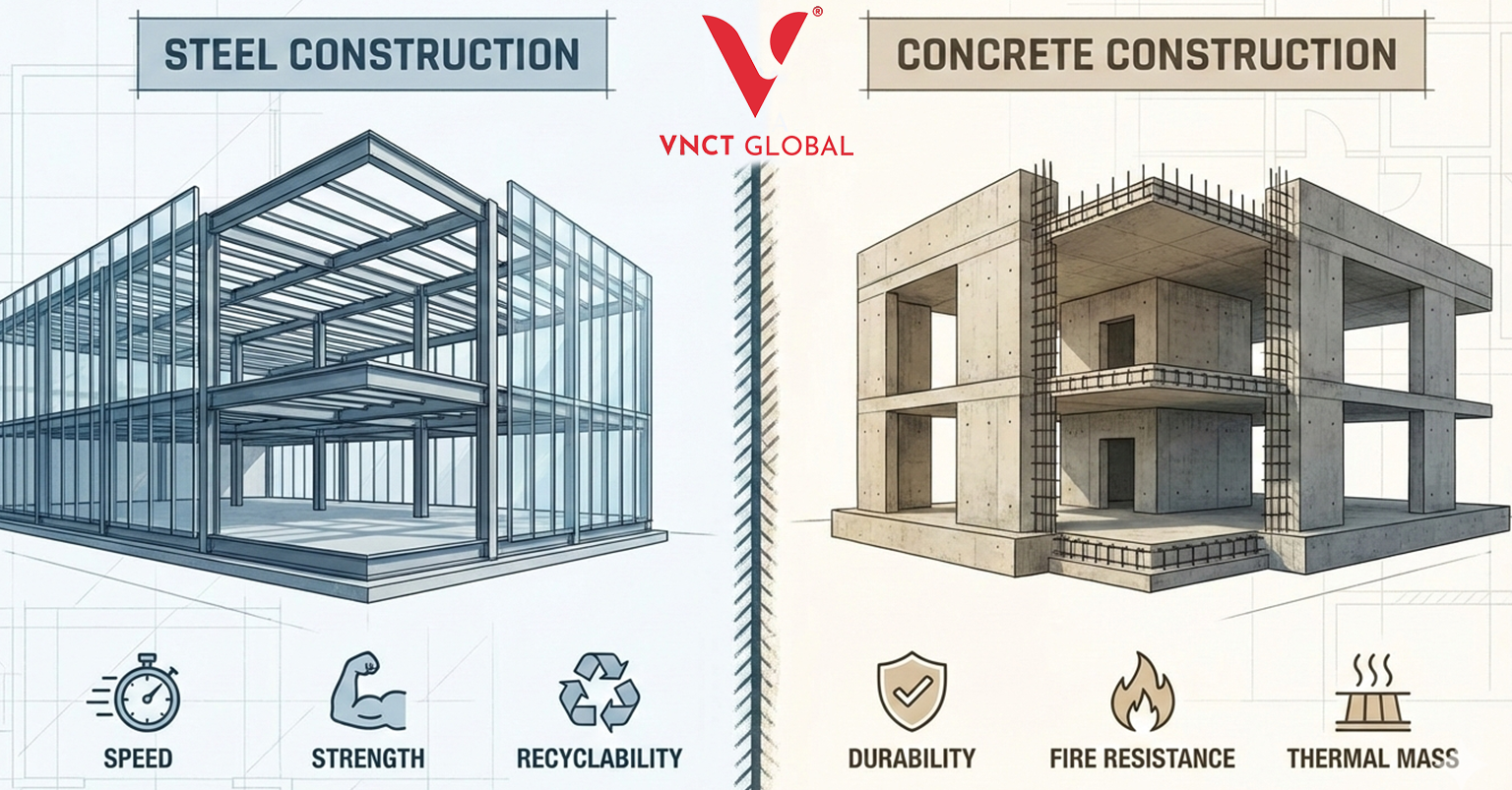
Concrete excels in compressive strength, making it ideal for residential foundations and load-bearing walls. Steel, on the other hand, is superior in tensile strength, making it suitable for large spans and flexible designs.
Construction Speed
Steel structures can be fabricated off-site and assembled quickly, reducing construction time. Concrete construction takes longer due to curing time but offers more customization at the site level.
Design Flexibility
Steel allows for open layouts and modern designs. Concrete offers solidity and thermal comfortimportant for villas meant for long-term living.This is why experienced names among the largest villa developers in India often use a hybrid approach, combining reinforced concrete with selective steel components.
Practical Considerations
1) Fire Resistance
Concrete has a natural advantage when it comes to fire resistance. It does not burn, melt, or emit toxic fumes. Steel, while non-combustible, can lose strength at high temperatures unless treated with fire-resistant coatings.
For residential villasespecially NRI-owned homes that may remain unoccupied for monthsfire resistance is a major reason concrete remains the preferred choice.
2) Corrosion and Environmental Impacts
Steel is vulnerable to corrosion, especially in coastal regions. Projects near the sea, such as Ocean drive villas or Palm Beach, require heavy anti-corrosion treatment if steel is used extensively.
Concrete performs better in humid and coastal environments when properly constructed. This is why villas in Chennai’s coastal belts rely more on reinforced concrete structures.
3) Weight and Foundation
Concrete structures are heavier and require stronger foundations. Steel structures are lighter, reducing foundation costs in certain soil conditions.
For villas, concrete doesn’t become a drawback. Its added weight actually helps make the structure more stable and improves both insulation and soundproofing, which matters to high-end homebuyers.
4) Maintenance and Lifecycle Costs
Concrete structures demand lower maintenance over time. Steel structures may require periodic inspections, repainting, and corrosion control.
For NRIs who plan to own a property long term and can’t oversee it regularly, concrete villas with minimal maintenance make a real difference. This is why developers such as VNCT Global focus more on long-lasting strength than on short-term cost cuts.
Which Material Fits What Scenario?
Scenarios Where Steel Is a Better Choice
Steel works well when:
- Construction timelines are extremely tight
- Large open spaces are required
- The structure is temporary or semi-permanent
- Architectural flexibility is a top priority
Some developers use steel for pergolas, car sheds, roofing systems, or design accents in modern villas.
Scenarios Where Reinforced Concrete Is a Better Choice
Concrete is ideal when:
- Building independent villas or gated communities
- Long-term durability is critical
- The project is in coastal or high-humidity regions
- Low maintenance is a priority
- Thermal comfort matters
Most villas in Chennai, villas in Madurai, and villas in Coimbatore are built using reinforced concrete for precisely these reasons.
NRI Perspective: Steel vs Concrete for Overseas Buyers
For NRIs, the decision between steel and concrete goes beyond engineeringit’s about trust, longevity, and hassle-free ownership.
NRIs investing after attending events in Dubai often prioritize:
- Structural longevity
- Minimal maintenance
- Strong resale value
- Clear legal and construction transparency
Concrete villas score higher on all these parameters. This is why reputed brands among the best villa developers in India focus on concrete-based construction for NRI-targeted projects.
How VNCT Global Supports NRI Buyers
VNCT Global understands that NRIs need clarity, not complexity. Their approach to construction is rooted in reliability, not trends.
Here’s how they support NRI buyers:
- Clear explanation of construction materials used
- Structural transparency and quality assurance
- Regular photo and video updates during construction
- Trusted project delivery across Park villas, Creek residences, and Brookside residences
- Guidance on long-term maintenance planning
Whether you’re investing remotely or planning to move back in the future, VNCT Global ensures the structure you buy today stands strong decades later.
You can always contact us VNCT Global to understand why material choice plays a critical role in long-term villa value.
Conclusion
The debate around Steel vs Concrete doesn’t have a one-size-fits-all answer. Steel offers speed and flexibility, while concrete delivers durability, safety, and peace of mind.
For residential villasespecially those built for families and NRIsreinforced concrete remains the most reliable choice. That’s why the largest villa developers in India continue to rely on concrete for premium villa communities.
Choosing the right material is not about trendsit’s about how you want to live, invest, and secure your future.
FAQs for Steel vs Concrete
- Is steel construction safe for villas in India?
Yes, but it requires proper fireproofing and corrosion control, especially in coastal areas. - Why do most villa developers prefer concrete?
Because concrete offers durability, fire resistance, low maintenance, and better thermal comfort. - Is steel construction cheaper than concrete?
Not always. While steel may reduce construction time, long-term maintenance costs can be higher. - Which is better for NRI investmentsteel or concrete villas?
Concrete villas are generally better suited for NRI investors due to longevity and lower upkeep. - How does VNCT Global ensure construction quality?
Through proven material selection, experienced engineering teams, and transparent updates throughout the project lifecycle.