Introduction
Water Cement Ratio in Concrete Guide is a useful starting point for understanding how strong and durable concrete is produced. Whether you are constructing a new house, building a villa or planning a major renovation, the amount of water mixed with cement has a direct influence on concrete quality. Adding too much water can reduce strength and increase porosity, while using too little can make the concrete difficult to place and compact. Understanding the correct water-cement ratio helps homeowners make informed construction decisions and understand why engineers carefully control the materials used in every concrete mix.
Quick Answer
The water-cement ratio is the weight of free water divided by the weight of cement in a concrete mix.
Formula:
Water-Cement Ratio = Weight of Water ÷ Weight of Cement
For example, if a mix contains 50 kg of cement and 22.5 kg of free water:
22.5 ÷ 50 = 0.45
This means the water-cement ratio is 0.45.
A lower ratio can generally produce stronger, less permeable concrete when the mix is properly designed, placed, compacted and cured. However, the correct value depends on the concrete grade, materials, workability requirements and exposure conditions. It should be determined through an approved concrete mix design rather than a fixed rule for every project.
What Is the Water-Cement Ratio in Concrete?
The water-cement ratio, commonly written as w/c, describes the proportion of water compared with cement in a concrete mix. It is calculated by weight, not simply by estimating how many buckets of water are added.
Water plays an important role in concrete production. It reacts chemically with cement through a process called hydration, which helps the concrete develop strength. It also makes the fresh mix workable enough to be transported, placed and compacted.
However, more water does not automatically mean better concrete. Excess water can leave additional pores as the concrete hardens, affecting its strength and durability.
It is also useful to understand the difference between two terms:
- Water-cement ratio (w/c): Water compared with cement by mass.
- Water-cementitious materials ratio (w/cm): Water compared with the combined mass of cement and other cementitious materials, such as fly ash or GGBS.
The appropriate calculation depends on the materials used in the mix.
Why Is Water-Cement Ratio Important?
The ratio influences several properties of fresh and hardened concrete.
1. Concrete Compressive Strength
Compressive strength describes the ability of concrete to withstand a compressive load. When excess water is added, it can create more capillary pores in the hardened concrete, reducing its strength.
Maintaining the approved water-cement ratio helps concrete achieve the strength specified in the structural design.
2. Durability of Concrete
Concrete structures are exposed to moisture, temperature changes and environmental conditions throughout their service life.
A properly designed and compacted mix with suitable permeability helps protect the concrete and embedded reinforcement from deterioration.
3. Workability During Construction
Workability refers to how easily fresh concrete can be mixed, transported, placed and compacted.
If the mix is too stiff, workers may find it difficult to place concrete around reinforcement and into formwork. If it is too wet, segregation and bleeding may occur.
The objective is to achieve the required workability without adding uncontrolled quantities of water.
4. Porosity and Water Permeability
Excess water can leave additional voids in hardened concrete. This may allow water and harmful substances to penetrate more easily.
Controlling the water-cement ratio, along with proper compaction and curing, helps produce denser concrete.
5. Risk of Cracking
Excess water can increase drying shrinkage, which may contribute to cracking. Poor compaction and inadequate curing can create further problems.
The correct mix design and good site practices work together to reduce these risks.
Water-Cement Ratio Formula and Calculation
The formula is straightforward:
Water-Cement Ratio = Weight of Free Water ÷ Weight of Cement
Consider a simple example using one standard 50 kg cement bag.
| Material | Quantity |
| Cement | 50 kg |
| Free water | 22.5 kg |
| Water-cement ratio | 0.45 |
Calculation:
22.5 ÷ 50 = 0.45
Since one litre of water weighs approximately one kilogram under normal conditions, 22.5 kg of water is approximately 22.5 litres.
How Much Water Is Required for One 50 kg Cement Bag?
The following table shows example calculations for different water-cement ratios.
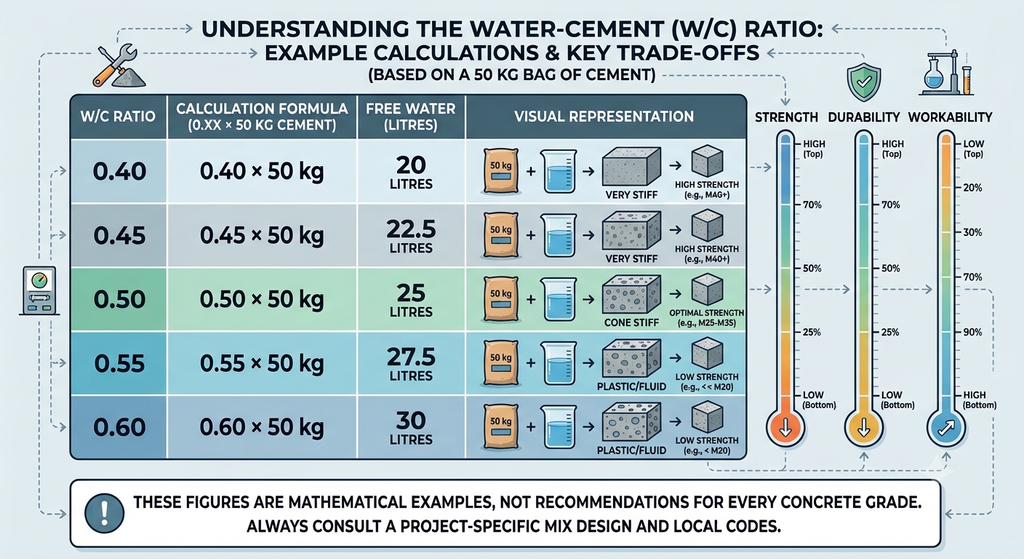
| Water-cement ratio | Free water for 50 kg cement |
| 0.40 | 20 litres |
| 0.45 | 22.5 litres |
| 0.50 | 25 litres |
| 0.55 | 27.5 litres |
| 0.60 | 30 litres |
These figures are mathematical examples, not recommendations for every concrete grade.
The actual water quantity must follow the approved mix design. Moisture already present in sand and aggregates, as well as water contributed by admixtures, must also be considered. Therefore, the quantity poured separately into a mixer may be lower than the total calculated free-water quantity
Water-Cement Ratio for Different Concrete Grades
Concrete is commonly identified by grades such as M20, M25, M30 and M35. The number represents its characteristic compressive strength at 28 days, expressed in N/mm².
However, each grade does not have one universal water-cement ratio.
The mix designer considers the required strength, cement properties, aggregate characteristics, workability and environmental exposure before selecting the ratio.
For example, an M25 mix prepared with one source of cement and aggregates may require a different ratio from an M25 mix made with different materials.
The final value is established through concrete mix design and trial mixes. It must also satisfy the applicable durability requirements.
Maximum Water-Cement Ratio Under IS 456
IS 456:2000 specifies maximum water-cement ratios for concrete depending on exposure conditions. The following are commonly referenced limits for reinforced concrete under those conditions.
| Exposure condition | Maximum water-cement ratio |
| Mild | 0.55 |
| Moderate | 0.50 |
| Severe | 0.45 |
| Very severe | 0.45 |
| Extreme | 0.40 |
These are maximum durability limits, not automatic mix-design recommendations. The engineer must select a ratio that also satisfies the strength requirements. Where the strength requirement calls for a lower value, the lower value is adopted.
Factors That Affect Water-Cement Ratio
The required ratio can change depending on the materials and construction conditions.
1. Concrete Grade and Strength Requirements
Higher-strength concrete generally requires careful control of the mix proportions. The selected ratio must achieve the specified target strength.
2. Cement Type
Different cement types and cement properties can produce different strength results at the same water-cement ratio.
3. Sand and Aggregate Quality
Aggregate size, grading, shape, texture and moisture content influence the amount of water needed for the required workability.
4. Environmental Exposure
Concrete exposed to rain, groundwater, coastal conditions or aggressive environments may require stricter durability provisions.
This is particularly relevant when planning buildings in coastal parts of Tamil Nadu.
5. Required Workability
Concrete used in columns, beams, slabs and heavily reinforced sections may have different placement requirements.
The required workability should be achieved through mix design and suitable admixtures rather than uncontrolled water addition.
6. Chemical Admixtures
Water-reducing admixtures and superplasticisers can improve workability without requiring the same increase in mixing water.
Their type and dosage must be approved as part of the mix design.
What Happens When Too Much or Too Little Water Is Added?
Incorrect water measurement is a common construction-site problem.
Problems Caused by Excess Water
Adding more water than specified can cause:
- Reduced compressive strength.
- Increased porosity and permeability.
- Bleeding, where water rises to the concrete surface.
- Segregation of concrete ingredients.
- Greater drying-shrinkage risk.
- Reduced long-term durability.
For example, a mix designed at a ratio of 0.45 will not remain at 0.45 if additional water is added without adjusting the mix.
Problems Caused by Insufficient Water
Using less water than required can also affect concrete quality.
- The mix may become difficult to place.
- Proper compaction may become difficult.
- Voids and honeycombing may develop.
- Reinforcement may not be surrounded properly.
- The concrete may not achieve the intended performance if placement and compaction are inadequate.
The aim is not simply to use the least possible water. It is to maintain the approved ratio while achieving the required workability.
Difference Between Water-Cement Ratio and Concrete Mix Ratio
These two terms are often confused, but they describe different things.
| Water-cement ratio | Concrete mix ratio |
| Compares water with cement by weight | Describes the proportions of cement, sand and coarse aggregate |
| Influences strength, workability and permeability | Describes the overall material composition |
| Example: 0.45 | Example: 1:1.5:3 |
A concrete mix design considers both the water-cement ratio and the proportions of aggregates. Neither should be selected independently without considering the required concrete performance.
How Does Water-Cement Ratio Affect 28-Day Concrete Strength?
Concrete strength is commonly assessed at 28 days after casting. This is an important reference point used in concrete mix design and quality testing.
The water-cement ratio influences how much pore space remains in the hardened concrete. An excessively high ratio can increase permeability and reduce compressive strength.
However, the ratio alone does not determine the final result. Proper batching, mixing, placement, compaction and curing are also necessary.
For residential construction, concrete used in foundations, columns, beams and slabs must meet the strength specified in the structural design.
A concrete cube test is commonly used to assess compressive strength. The test results help the engineer determine whether the supplied concrete meets the specified requirements.
How to Calculate Water Content After Aggregate Moisture Correction
One important detail that is sometimes overlooked during concrete mixing is the moisture already present in sand and coarse aggregates.
Aggregates may contain surface water, particularly after rainfall or when stored in damp conditions. This water contributes to the total mixing water and must be considered when calculating the quantity to add.
For example, assume the approved concrete mix requires 180 litres of total mixing water. If moisture corrections show that the aggregates contribute 12 litres of free water, the additional water to be introduced is approximately:
180 − 12 = 168 litres
This is a simplified illustration. Actual calculations must account for aggregate moisture content, absorption and the moisture condition used in the mix design.
Ignoring aggregate moisture can increase the actual water-cement ratio, even when workers measure the water added to the mixer correctly.
How to Maintain the Correct Water-Cement Ratio at a Construction Site
Good concrete quality depends on accurate measurement and consistent site supervision.
Here are practical checks that homeowners can understand and discuss with their construction team.
- Follow the approved mix design: Confirm the concrete grade and specified water-cement ratio before pouring.
- Measure materials accurately: Use proper batching and weighing equipment rather than estimating quantities.
- Check aggregate moisture: Wet sand and aggregates already contain water that must be accounted for.
- Avoid adding extra water: Do not allow workers to add water simply to make the concrete easier to pour.
- Use approved admixtures: Where additional workability is required, the engineer may specify a suitable admixture.
- Check workability: A slump test can help assess the consistency of fresh concrete against the specified requirement.
- Compact the concrete properly: Use suitable vibration and placement methods to reduce trapped air and voids.
- Cure the concrete correctly: Follow the specified curing method and duration to support proper strength development.
- Maintain test records: Keep relevant concrete test results and site-quality records.
These checks are especially important for structural elements such as foundations, columns, beams and slabs.
What Is the Difference Between Slump and Water-Cement Ratio?
Slump and water-cement ratio are related to fresh concrete quality, but they measure different things.
The water-cement ratio describes the quantity of free water compared with cement by weight. Slump measures the consistency and workability of freshly mixed concrete.
A slump test is commonly performed at construction sites to check whether concrete has the required workability for placement.
For example, concrete used in a heavily reinforced column may need a different workability level from concrete placed in a simple floor slab.
A higher slump does not automatically mean that extra water has been added. Suitable chemical admixtures can increase workability without unnecessarily increasing the water-cement ratio.
Similarly, a slump test cannot independently confirm the actual water-cement ratio. Batching records and mix-design information are needed for that purpose.
Water-Cement Ratio for Different Construction Applications
The concrete used in different parts of a house may have different strength, workability and durability requirements.
1. Foundation Concrete
Foundation concrete transfers building loads to the soil. Its mix design must consider structural requirements and the soil and groundwater conditions at the site.
2. Column Concrete
Columns carry structural loads from beams and slabs. The concrete must be workable enough to fill the formwork and surround the reinforcement properly without segregation.
3. Beam Concrete
Beams contain reinforcement and may have congested sections. Proper workability and compaction are essential to avoid voids and honeycombing.
4. Slab Concrete
Slabs require suitable workability for placing, levelling and finishing. Adding uncontrolled water to make the concrete easier to spread can affect its strength and durability.
5. Coastal Construction
Buildings near the sea may experience exposure to salt-laden air, moisture and other aggressive environmental conditions.
The engineer must identify the applicable exposure condition and specify concrete that meets the required durability provisions. This is particularly important for properties in coastal areas of Chennai and other parts of Tamil Nadu.
The water-cement ratio should always follow the approved structural design and concrete mix specifications rather than a general value selected for every application.
Common Water-Cement Ratio Mistakes to Avoid
Even when good-quality cement is purchased, incorrect site practices can affect the final result.
Adding Water Without Measurement
Estimating water by eye can change the approved ratio. Water should be measured and controlled.
Ignoring Moisture in Sand
Sand may contain surface moisture, particularly after rainfall. This contributes to the total mixing water.
Using the Same Ratio for Every Concrete Grade
Different grades and exposure conditions have different mix-design requirements. One ratio should not be used for every application.
Skipping Concrete Testing
Concrete quality should be checked through the tests specified for the project. Visual appearance alone cannot confirm compressive strength.
Neglecting Curing
Correct mixing is only one part of concrete quality. Proper curing is also necessary for the concrete to develop its intended properties.
How NRIs Can Monitor Concrete Quality When Building a Home in India
For many Non-Resident Indians, building a home in India is a long-term investment. However, managing construction from another country can be difficult.
You may be living in Dubai, the United Kingdom, Singapore or the United States while your property is being constructed in Chennai, Madurai or Coimbatore.
Concrete work is one of the stages that deserves attention because mistakes made during foundations, columns, beams and slabs may not be easy to identify after the structure is completed.
Here are some practical ways to remain involved.
Request the Concrete Mix Design
Ask the construction team for the approved mix design, including the concrete grade, water-cement ratio and material specifications.
Review Concrete Test Reports
Request relevant slump-test records and compressive-strength cube-test reports. These records help assess whether the concrete meets the specified requirements.
Arrange Virtual Site Inspections
Video calls and regular site photographs can help you understand the construction stage and discuss any concerns with the project team.
Keep Construction Records
Maintain copies of approved drawings, material specifications, test reports, invoices and progress photographs.
Ask Questions Before Concrete Pouring
Before a major concrete pour, confirm that the required materials, reinforcement, formwork and site arrangements have been checked by the responsible technical team.
Remote monitoring does not replace professional site supervision, but it helps overseas homeowners stay informed and involved.
How VNCT Global Supports NRI Homebuyers
Buying a villa in India while living overseas involves more than choosing a location. NRI buyers also need reliable property information, clear communication, documentation assistance and support throughout the purchase process.
VNCT Global works with NRI homebuyers interested in residential villa developments in South India. Overseas buyers can seek assistance with project information, virtual property visits, documentation-related support and investment guidance.
For people exploring villas in Chennai, villas in Madurai and villas in Coimbatore, understanding the project details and available support can make the property-buying process easier.
Some of VNCT Global’s residential developments include:
- Brookside Residences: A residential villa development in Pammal.
- Palm Shore: A villa development on Chennai’s ECR.
- Palm Beach: A residential project in Chennai.
- Creek Residences: One of VNCT Global’s residential developments.
- Park Villas: A villa development for buyers exploring residential options in Chennai.
- Ocean Drive Villas: A previously launched development where all units have been sold.
Buyers researching the best villa projects in Chennai, best villa projects in Coimbatore and best villa projects in Madurai should compare location, project documentation, construction specifications and the support available before making a decision.
VNCT Global also connects with overseas Indian audiences through events in Dubai and other international locations, helping prospective buyers learn about residential property opportunities in India.
When comparing the best villa developers in India, it is important to look beyond advertisements. Buyers should review the actual project portfolio, documentation, construction quality, delivery record and communication standards.
Similarly, people searching for the largest villa developers in India should assess the developer’s completed projects and track record rather than relying only on company size or promotional claims.
For anyone evaluating the best villa developers in India, clear project information and transparent communication should be part of the decision.
A reliable House construction company in Chennai should also explain the materials, technical specifications and quality-control practices followed during construction.
If you are planning to purchase a villa while living abroad, you can explore VNCT Global’s available developments and contact us VNCT Global to discuss your requirements.
Conclusion
The water-cement ratio is one of the important factors that determines the quality of concrete. It affects compressive strength, workability, porosity and long-term durability.
Using the correct ratio is not simply about measuring water against cement. It also requires an approved mix design, accurate batching, moisture correction, proper placement, compaction and curing.
Whether you are constructing a family home, investing in a villa or managing a property project from overseas, understanding these basics can help you ask better questions and follow construction quality more confidently.
Good construction depends not only on the materials used but also on how carefully they are measured, mixed and installed.
FAQs for Water Cement Ratio in Concrete Guide
What is the water-cement ratio in concrete?
It is the ratio of the weight of free water to the weight of cement in a concrete mix. It is calculated by dividing the water quantity by the cement quantity, both measured by weight.
What is the formula for calculating the water-cement ratio?
The formula is:
Water-Cement Ratio = Weight of Water ÷ Weight of Cement.
For example, 22.5 kg of water divided by 50 kg of cement gives a ratio of 0.45.What is the ideal water-cement ratio for concrete?
There is no single ideal ratio for every concrete mix. It depends on the required strength, durability, exposure conditions, materials and workability. The approved mix design determines the correct value.
How much water is required for one 50 kg bag of cement?
It depends on the specified ratio. At 0.45, the calculated free-water quantity is 22.5 litres. At 0.50, it is 25 litres. Aggregate moisture and other water contributions must be considered before deciding how much additional water to add.
Does a lower water-cement ratio always produce stronger concrete?
Not automatically. A lower ratio can improve strength and reduce permeability, but the concrete must still be workable enough to place and compact properly. Poor compaction can create defects even in a low-water mix.
What happens if too much water is added to concrete?
Excess water can increase porosity, reduce compressive strength, cause bleeding and segregation, and increase the risk of shrinkage-related problems.
What is the difference between water-cement ratio and concrete mix ratio?
The water-cement ratio compares water with cement by weight. The concrete mix ratio describes the proportions of cement, fine aggregate and coarse aggregate.
How does water-cement ratio affect concrete durability?
An excessively high ratio can increase the amount of connected pores in hardened concrete, allowing water and harmful substances to penetrate more easily. Proper mix design and curing help improve durability.
How can the water-cement ratio be checked at a construction site?
It can be checked through the approved mix design, accurate batching records, water measurement and aggregate-moisture corrections. Slump tests assess workability, while cube tests help assess compressive strength.
How can NRIs monitor concrete quality when constructing a house in India?
NRIs can request mix-design documents, concrete test reports, construction photographs and regular video updates. Virtual site inspections can also help them discuss construction progress with the project team.